Prestigious international journal recognizes NWMO scientists' work on copper-coating safety
A group of Nuclear Waste Management Organization (NWMO) scientists recently published an article in the prestigious international, peer-reviewed journal,
Progress in Materials Science, which reviews decades of work in corrosion to support the safety of the NWMO copper-coated used fuel container.
The article, which can be accessed
here, explains how the containers will withstand corrosion processes for more than one-million years, states an NWMO press release, issued Dec. 11.
Dr. Peter Keech, NWMO manager of engineered barrier science and the article’s senior author, states the following:
“This paper shows that we can reasonably expect about 0.25 of a millimetre of corrosion to occur over a million years. Even if you conservatively presume a series of unlikely events, the total damage will be less than 1.25 millimetres. When we consider that the reference thickness of the copper coating is three millimetres, it is clear that we can depend on the container to safely isolate the used nuclear fuel from people and the environment, as part of a multiple-barrier system, even as we account for corrosion.”
This work builds on the expertise and knowledge the NWMO has incorporated into its work. In 2014, the NWMO refined its container design to one that is optimized for the used CANDU fuel produced by Canadian nuclear power reactors and since then, the NWMO’s research program and container design have continued to advance.
The used fuel containers are engineered to remain intact and keep the used nuclear fuel completely isolated until the fuel’s radioactivity has decreased to levels of natural uranium. The container prevents radionuclides in the fuel from escaping into the underground environment and is able to withstand pressures of the overlying rock and loading from three-kilometre-thick glaciers during a future ice age.
The NWMO scientists’ work demonstrates a copper coating is an effective barrier to safely contain used nuclear fuel and can “withstand even the harshest conditions” that may be present inside a Deep Geological Repository (DGR) in Canada.
The findings in the article, titled “
An Evaluation of Corrosion Processes Affecting Copper-Coated Nuclear Waste Containers in a Deep Geological Repository,” confirm that the copper coating on an NWMO-designed container for used nuclear fuel, is robust and thick enough to withstand any corrosive effects for more than one-million years.
The container is one of
five barriers that will ensure a
DGR can safely contain and isolate radioactive material for hundreds of thousands of years.
“The publishing of this article in such a prestigious peer-reviewed journal, is a testament to the high-quality work being produced by NWMO specialists,” said Derek Wilson, NWMO’s chief engineer and vice-president, contract management. “The article’s findings also underscore that the proposed repository design will withstand even the harshest conditions to ensure that people and the environment are protected for generations to come.”
The article reviews hundreds of research articles relevant to the long-term integrity of copper coatings, spanning nearly a century of peer-reviewed scientific publications. It serves both as evidence of the safety of the design for Canada’s plan and to inform similar international projects that rely on copper, but with different geospheres, container designs and nuclear materials.
In addition, the article reviews past research to calculate what level of corrosion is possible in a repository environment. Also examined, are a myriad of possible corrosive factors, such as exposure to groundwater and the potential influence of microbial communities. The NWMO’s design calls for a three-millimetre copper coating on the used fuel container.
The article was co-authored by NWMO corrosion scientists Dr. Mehran Behazin and Dr. Jeffrey Binns, as well as frequent NWMO collaborator and contractor Dr. David S. Hall, who is currently managing a research consortium across the United Kingdom from the University of Cambridge.
The NWMO is a non-profit organization tasked with the implementation of Canada’s plan for the safe, long-term storage of used nuclear fuel inside a DGR in a manner that protects people and the environment.
“Progress In Materials Science” is an international review journal that focuses on advances in the science of materials as they relate to engineering.
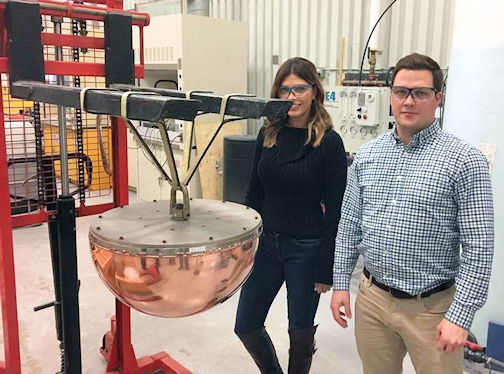
Nuclear Waste Management Organization (NWMO) corrosion scientists Dr. Mehran Behazin (left) and Dr. Jeffrey Binns pose with a section of a prototype of the copper-coated used nuclear fuel container; photo courtesy of the NWMO
 Written By
No bio for this author.



Related Stories
No related stories.