Swedish nuclear waste expert, mayor share experiences with South Bruce community
Prioritizing sound science, trust, and authenticity is among the key factors in siting a nuclear waste project, says Swedish nuclear waste expert Saida Laârouchi Engström.
The former vice-president of the Swedish nuclear waste management company, Svensk Kärnbränslehantering Aktiebolag (SKB), made a presentation to the South Bruce Community Liaison Committee (CLC) Thursday evening, Sept. 2.
She was joined by Jacob Spangenberg, mayor of Östhammar, speaking about their processes and experiences with the SKB national project.
Engström outlined various components of the program, such as the transport of the used nuclear fuel, which in Sweden is largely done by sea. She also explained the design of SKB’s multi-barrier system for containing the waste, with some similarities to the barrier system that the Nuclear Waste Management Organization (NWMO) is planning in Canada.
Sweden has several operating laboratories to investigate and study various components of the SKB project, such as the canister, bentonite and hard rock. Engström noted that building public trust includes showing the benefits as well as openness to the challenges, impacts, and local concerns.
“You have to show the positive aspects of the repository… openness about the challenges, about what you know and what you don’t know,” she said. “And you need to be open to listen to the concerns and views of the local people.”
Similar to South Bruce and Ignace, the two communities remaining in the NWMO’s site-selection process, Östhammar was one of several potential host communities in Sweden that, after studies and investigation, was chosen as the site for the SKB project.
Spangenberg said that for more than 40 years, there have been nuclear facilities in the municipality, with the site for the Deep Geological Repository (DGR) selected in 2009.
Regarding the siting of SKB’s used nuclear fuel project, he noted that the municipality has three key priorities: participation in decision-making from start to finish, that the terms and conditions are clearly defined, and that there is transparency in the decision-making process by other authorities in the country.
For the community, Spangenberg said the “main concern has been knowledge and understanding of what was going to happen and how it might affect the municipality in the future.”
He also detailed the various steps in the licensing process, including the municipality, Swedish government, Land and Environment Court, and the Swedish Radiation Safety Authority.
Like Engström, Spangenberg closed by reflecting on key take-aways from their experience so far. He pointed to co-operation between municipalities, openness and the necessity of financing.
The next CLC meeting will be held Oct. 7, at 7 p.m., via Zoom.
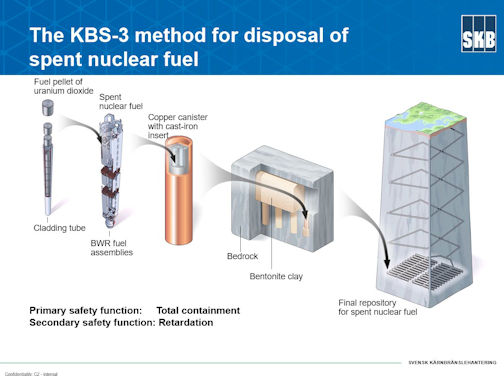 A screenshot from Swedish nuclear waste expert Saida Laârouchi Engström’s presentation, highlighting the barrier system for used nuclear fuel in Sweden; photo courtesy of Steven Travale
 Written By
No bio for this author.



Related Stories
No related stories.