Kincardine man has seen a lot of changes in the past 90 years
Lynn Thomas Farrell of Kincardine has seen a lot of changes in the past 90 years.
Born Dec. 18, 1931, the son of Thomas and Hazel Farrell of Huron Township, he lived through the Great Depression and the Second World War. Plus, the year he was born, was the same year that Maple Leaf Gardens opened in Toronto, the ballpoint pen was invented, and the comic strip “Dick Tracy” was first published.
“I was young, but still witnessed the hardship of the Depression,” Lynn recalls. “People had no work, no unemployment insurance, no medical insurance. No one went to the hospital unless it was very serious. The local doctors would make house calls in all kinds of weather, even getting stuck on the road and walking in long laneways to help the sick.
“Men worked on farms if they could get a job - just for their food and board. The rest walked the road as tramps, stopping into houses (especially along the highways) to beg for food.”
In 1939, the hydro line went south down Highway 21. Lynn remembers it took one man all day to dig each hole if he worked hard in the dry clay. Then a cedar pole was put in the eight-foot by 30-inch hole.
“Hydro changed life a lot,” he says. “Up until then, most farms had only coal oil lanterns and lamps, no radios or indoor plumbing, a stove in each room (mostly the kitchen), no heat in the bedrooms. You had feather tick mattress and heavy blankets for a warm sleep in the winter time.
“Once hydro became available, every farmer soon got an electric-powered water pump, lights in the barn, and a milking machine – what a change! The Depression still was being a problem – gas was 25 cents a gallon, eggs were 15-20 cents a dozen, and an ice cream cone was five cents - a real treat then as no one had a fridge in the home.”
Also in 1939, the Second World War broke out, recalls Lynn.
“That ended the Depression and made for some quick changes,” he says. “Most physically-fit men, aged 17-25, joined the army, navy or air force. The rest went to work to supply the war effort, while gas, sugar, butter and oil were put on ration coupon books.
“Many cars got parked because tires were unavailable and there was no gas in the ration book. Farmers could get all the gas and oil they needed to fuel tractors and farm-related vehicles. The gas had purple dye added and if people got caught with coloured gas in their car, they got a heavy fine.”
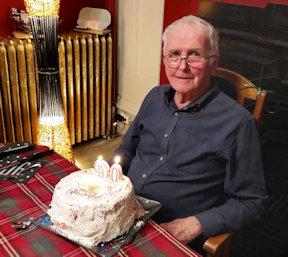
Lynn Farrell with his 90th birthday cake, Dec. 18, 2021, at the farm on Highway 9; photo by Eian Farrell
He remembers that Malcolm’s Furniture Factory in Kincardine built airplane wings and parts. “There was a guard house at all four corners, with an armed guard on duty 24/7.”
The war years brought many changes. “Farming became mechanized, combines replaced threshing machines, tractors replaced horses, and equipment was put on rubber tires. The stores went to self-serve operations, company-owned chain stores and mall-sized.
“The Douglas Point Nuclear Station came and paid big wages. The local factories all closed because they just could not pay the same wage. The real estate took off and the house-building started making work for all.
“During the war years, the Commonwealth Airport was built at Port Albert, and Highway 21 was paved south to Goderich. Then, in 1946, Highway 21 had new culverts and bridges installed and the roadway widened and paved. The sharp turn to go west at the Southline was eliminated and a long curve made where it joined Highway 21 on Kincardine Avenue.
“A big bulldozer, pulling a big earth scraper, got stuck. Two high-hoes dug until you could not see either the bulldozer or scraper at ground level. Then it took two more big caterpillars to get the stuck bulldozer and scraper up and on firm ground – what a mess!”
Lynn says the sharp corner the new curve eliminated had been a real dangerous intersection with many roll-overs into the field and T-bone collisions. Due to the dust and speed and poor signage, people would not see the abrupt turn until it was too late, and accidents happened often.
Kincardine had a population of 2,626 in 1946, he recalls. “The town’s big white sign with black lettering said ‘Welcome to Kincardine – Where you’re a stranger only once.’
“The town had only one policeman up to this time and he could name a deputy if a big event was planned, to assist or help him but there was never any serious crime.
"From the 1970s, the big, rapid happenings really changed our area, thanks to the construcction of the Bruce Nuclear Power Development (now Bruce Power and Ontario Power Generation).”
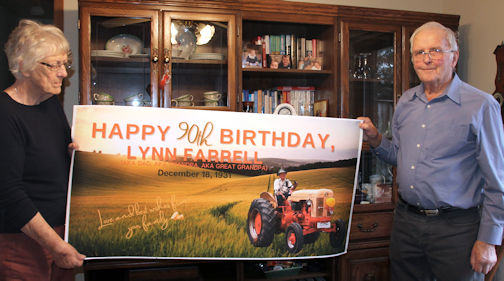 Lynn Farrell (right) and his wife, Marj, of Kincardine hold up the banner, celebrating his 90th birthday
Lynn was raised three miles south of Kincardine, with three brothers and one sister, on Highway 21 which was a gravel road and graded with horses pulling a drag.
“In 1930, in a bad winter, the highway would be closed to only horse-drawn sleighs and cutters, and would be built up with packed ice and snow,” he recalls. “One spring, it did not get open until late April. A big TD18 International bulldozer with a V-plow and double wings came from Brampton. Some pieces of ice were still visible till May.”
The worst winter blizzard he can remember, was in March of 1947. “I didn’t see a vehicle in or out of town for 10 days, even the railroad was blocked. It took three steam engines pushing the plow and another pulling a passenger car full of men with shovels to dig the plow out. It would be stuck and wedged in so bad, it couldn’t back up till the workers dug it free.
“Just north of the Bluewater Agra Plant on a cold but sunny Sunday, I watched the show. I could walk right over the telegraph wires, the snow was so deep. Back then all train stations had a telegraph office and sent telegrams by Morse Code for communication, for any distance out of town. It was more reliable than a telephone.”
Lynn remembers Saturday nights in downtown Kincardine.
“Everyone went to town to buy groceries and visit and pass the latest news and gossip,” he says. “The stores stayed open till 10 p.m. In the cold weather, some stores had a coal or wood-fired furnace in the basement but other stores with non-perishable goods just had a pot-bellied stove at the back near the cash register. Bolts, etc., would nearly stick to your bare hand. There was no plastic; everything was in paper wrap or boxes or kegs.
“The Kincardine Scottish Pipe Band played every Saturday night. The old incandescent lights weren’t so bright. The night hawks would be swooping down over main street making their loud call. The young people all went to the Beach Pavilion to dance. Highway 21 was part of main street then (1935-40) and in the summer it could be a problem to cross the street, there was so much traffic.
“There were four grocery stores, two bakeries, three jewellery stores, four butcher shops, three variety stores, four restaurants, two hotels, and three barber shops.
“The people of Kincardine worked in Malcolm’s Furniture Factory on Princes Street, and Coombe's Furniture Factory on Huron Terrace, by the harbour, or the Circle Bar Knitting Mill (now the town’s main parking lot), plus other small shops.
“Sunday morning most families went to church. The Sunday Schools were full at all churches, where they taught the 10 Commandments, the Lord’s Prayer and the Apostle’s Creed, and most abided by that teaching.
“Sunday afternoon, Station Beach would be crowded and the high diving tower, about 35 feet high, and the long springboard drew a crowd of young people on the north pier, to show their skill in the summer. Many young guys would jump off the top of the high-sided bridge that crossed the river on Huron Terrace – usually on a dare – but it took some nerve.”
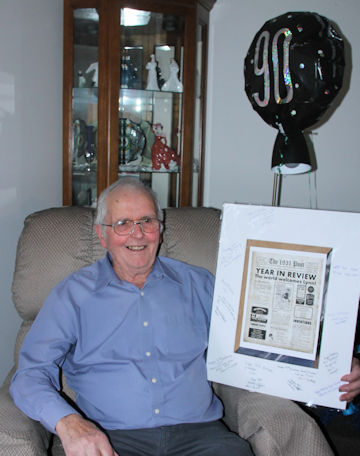
Lynn Farrell smiles as he holds up a poster, marking all the things that happened in 1931, the year he was born
Lynn and his wife, Marj have been married for almost 70 years. They will celebrate their 69th wedding anniversary Jan. 24.
They operated their farm on Highway 9 until January, 1991, when they moved to their new home on Campbell Avenue in Kincardine. They have three children: Clayton and his wife, Brenda, who live on Highway 9; Connie and her husband, Mike Murphy, of London; and Eian and his wife, Jennifer, who live on the farm on Highway 9. They also have eight grandchildren and 12 great-grandchildren.
As he celebrates being 90 years old, Lynn credits his longevity to good, solid genes.
“My grandfather, Billy Emmerton, lived to be 96,” he says, “and my grandmother, Mary Farrell, lived to be 95. My brother, Bob, is just 14 months younger than I am, and he turns 89 in February.”
The family held a birthday celebration in London back in November, presenting him with a banner that features him driving his 1956 Case 400 tractor. “I asked my granddaughter why they held my party early; were they worried I wouldn’t make it?”
He was also honoured with a party at the farm, on his actual birthday, Dec. 18.
So, how does it feel to be 90 years old?
“Not much different,” says Lynn. “I’m slowing down a bit, though. For the first time, I’m not going to be out feeding the cattle at the farm. My body is telling me that I’m not as young as I once was.”
Lynn enjoys gardening, bird-watching, cutting the grass, vacuuming, and playing cards.
“I’ve always said that I’m so lucky to be born and raised here; to live in this part of the world and this time in history to see all the changes in this area that make life healthier and easier, as I’ve seen it for 90 years. It’s like the Garden of Eden.”
What’s his advice to others who want to live a long and happy life?
“Have porridge for breakfast,” jokes Lynn. “Make sure you have three square meals a day – not always at the table and not on time! And for me, it was always important to finish the job.”
 Written By
Liz Dadson is the founder and editor of the Kincardine Record and has been in the news business since 1986.



Related Stories
No related stories.