Kincardine Christmas Bird Count reports two new species
Kincardine’s 41st Christmas Bird Count was held Thursday, Dec. 16. Unfortunately, a one-day wind event hampered searchers’ efforts. Luckily, mild temperatures and a lack of snow made all secondary roads passable and still water was not frozen.
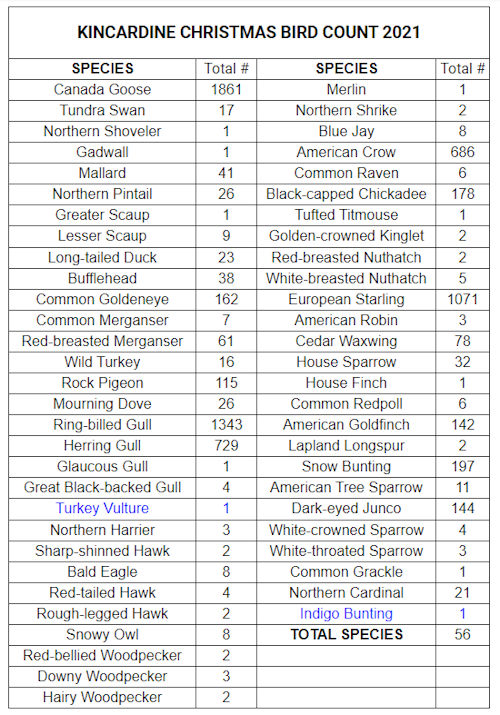
The 56 species found is average but the total number of birds counted was way low. The group didn't even see a woodpecker all day. The high wind kept birds out of sight. The count day's weather gets recorded and tabulated into graphs of birds per man-hour. This helps researchers understand why the low number of birds was found.
Highlights include two new species to the Kincardine count: tje Turkey Vulture and Indigo Bunting.
Turkey Vultures are large raptors commonly seen in Bruce County during summer but it wasn’t always so. Before the 1950s, they were unheard of in Ontario but during the ‘60s, their population exploded.
Vultures are a large carrion-eating raptor that can be mistaken for an eagle. Unlike Bald Eagles, vultures actually have bald heads, so they don't get bloodied feathers while eating roadkill. In-flight, they soar with a slight ‘V’ in their wings. Bald Eagles soar with their wings out flat.
Vultures are masters of thermals and soar great distances with nary a flap. They find prey with their excellent sense of smell.
More recently, a second species of vulture arrived in Bruce. The Black Vulture, first sighted in July, 2000, is slightly smaller than the Turkey Vulture. It is the most common vulture in the western hemisphere. It doesn't have as good a sniffer as Turkey Vultures but relies on its keen eyesight to find kills.
California Condors are the largest North American vulture but are nearly extinct. Luckily there is a captive population and some birds are being released to the wild.
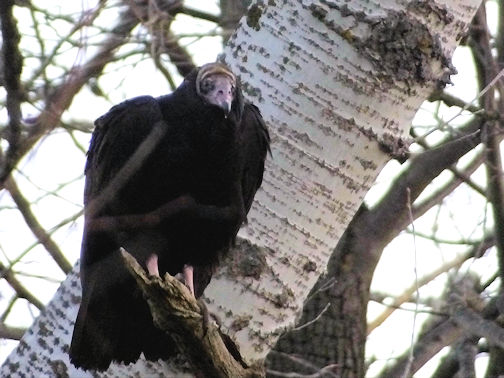 First-ever Turkey Vulture, seen on the Kincardine Christmas Bird Count; this immature bird has a black featherless head; when an adult, the head will be red; photo by James Turland
The Indigo Bunting was found at Bruce Beach and continues to visit a bird feeder daily. It is considered a ‘vagrant’ or ‘out-of-season’ species. Like many of the summer song birds, Indigos winter south in Mexico and beyond. This one got left behind.
Adult male Indigos are a stunning brilliant blue but only if seen in the right light. Blue is the only feather colour that is not a pigment. The colour is caused by microscopic particles in the feathers that refract light and create blue much the same way the sky does. The blue is best seen if you are between it and the sun; otherwise, the bird appears grey or black.
Many birds moult and appear drabber in winter plumage. They are most colourful during the breeding season. In winter, Indigos look mostly brown with only a hint of blue in the tail. You have to look carefully to spot it among the Juncos. However, Indigos are a common nester in Bruce and if you become familiar with its mnemonic call, “fire fire where where put it out put it out,” you might find one in your backyard.
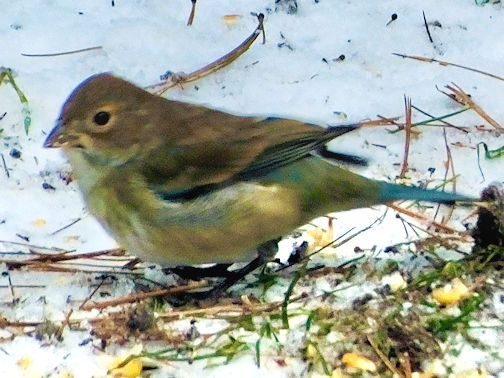 Vagrant Indigo Bunting found at a feeder; note the blue tail; photo by James Turland
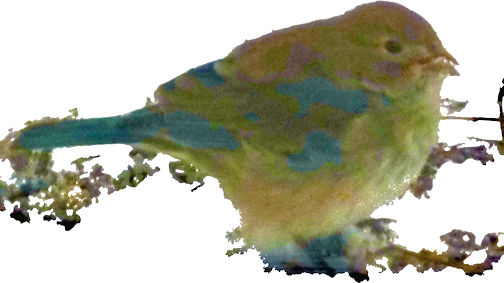 An enhanced photo of the same Indigo Bunting shows hidden blue; photo by James Turland
Two other rare birds seen on the count were the Tufted Titmouse and Red-headed Woodpecker. Both of these species are more at home south of here in the Carolinian Forest.
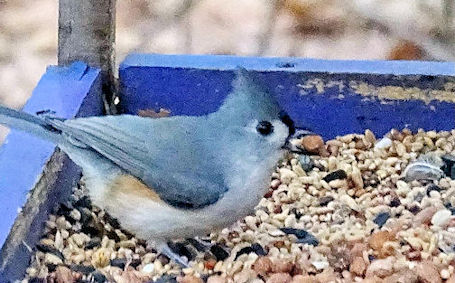
The Tufted Titmouse is a close relative of Chickadees but can be identified by its crest. Red-headed Woodpeckers are a bird of concern because populations have severely declined recently. It is an unusual woodpecker because it catches insects on the wing and stores food in hidden caches for later.
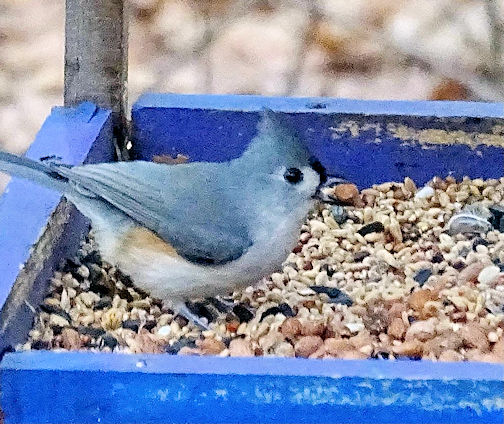 The Tufted Titmouse is a regular visitor to the feeder; photo by O. Visser
Here is some other “birdie” news from Bruce County.
Each calendar year, eBirders see more than 250 bird species in Bruce County. The eBird app is replacing the paper records that birders used to keep. The eBird automatically keeps track of time and place and you simply enter your bird sightings.
Rarities are the delights of birders and by sharing on eBird, more people get to enjoy the bird. The county bird list continues to grow partly because birding is so popular now.
Climate change also contributes to rare sightings as birds are blown off course and are venturing north of their historic ranges. Present eBird records show 331 species on Bruce County's all time list. Some recently accepted sightings include the Cinnamon Teal and Laughing Gull.
Cinnamon Teal are common ducks in western North America but are rare visitors to Ontario. As the name implies, the male bird has a dark red cinnamon colour. The first Bruce County Cinnamon Teal was seen in Kincardine May, 2020.
Laughing Gulls are an east coast species but do wander occasionally to the Great Lakes. It was seen at the Bruce Peninsula Bird Observatory June, 2021.
A ‘bird alert’ for an avid birder trumps almost any other calling. Depending on rarity and dedication, some birders will stop whatever they are doing to go on the CHASE. Chasing has many slangs including “twitching,'' and can become an obsession. Chasing means going after a species reported by someone else.
When you begin birding, it is quite easy to chase down new species (lifers) but it exponentially gets very hard to add new birds. Good advice for chasing is, “Go as soon as you can and stay as long as it takes.”
Birders vary from those happy to enjoy backyard sightings to those on worldly quests to see as many species as possible in a calendar year. These so-called "Big Year" quests are a huge commitment. The present Ontario Big Year record is 346 species seen by Jeremy Bensette in 2017. This year, Kiah Jasper, the youngest member of the Bruce Birding Club, is doing a Big Year and is off to a fabulous start. You can follow Kiah's Big Year at his blog called “Chronicles of an Ontario Birder.”
Additionally, this year, the third ‘Ontario Breeding Bird Atlas’ project began. The success of this enormous project relies on the province’s birders volunteering. The goal of the Atlas is to map the distribution and abundance of Ontario’s approximately 300 species of breeding birds. If you discover a nest and would like to contribute to this project, contact
jaturland@gmail.com.
Not only is bird-sighting information fun to collect, it is cited in many scientific papers. Because of birds' flighty nature, they are good indicators of environmental health. Forty years ago, Bald Eagles neared extinction and are partly responsible for the elimination of DDT. Bald Eagles recovered and are now a common sight in the county. One of the best eagle-viewing locations is Baie Du Dore in winter.
Now, insect eaters, such as swallows, are in danger. Purple Martins were once abundant in the county; last year was the first time we didn’t see a single Martin. Hopefully, we can discover why and help Martins to recover as did the Bald Eagles.
For more information about local birds, visit the
Bruce Birding Club web page. If you are interested in participating in next year’s Christmas Bird Count or would like to join the Bruce Birding Club on one of its bi-monthly outings, contact
jaturland@gmail.com.
The following chart is a complete list of birds seen on the count.
 Written By
No bio for this author.



Related Stories
No related stories.