The arrival of hydro in rural Ontario
It is difficult to remember that we didn’t always flick a switch to access light, heat and the use of all the appliances and equipment that are common today. The suggestions that warn us to “Be Prepared for 72 hours” when a wind or snowstorm is forecast, remind us of life before electricity. I am amused that the everyday word here (in New Brunswick) is power. In Ontario, we usually said hydro.
As early as 1937, my father-in-law, Clarence, was seeking information from the Hydro Electric Power Commission of Ontario, regarding the installation of hydro lines in Glenelg Township, Grey County. At that time, the monthly consumption rate for farmers was as follows:
- Six cents per kilowatt-hour (kwh) for the first 42 kilowatt-hours
- Two cents per kwh for the next 108 kilowatt-hours
- Three-quarters of a cent per kwh for the balance of consumption
Letters in the family archives indicate the necessity of visits to Toronto to talk with government officials. However, it was not until August, 1948, that an application form was submitted.
Meanwhile in Bruce County, a similar project was under way. Dec. 17, 1948, Daddy signed the necessary papers to give the go-ahead for the installation.
I remember watching Lloyd Quinn install the necessary wires, outlets and switches in the house and barn on Pleasure Valley Farm in the fall of 1949. We kids quickly amassed a collection of the coin-like metal circles that were discarded during the job. They served well as money when we played store.
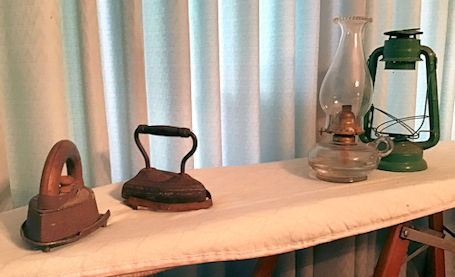
Oct. 11, an inspector was on hand, and Nov. 1, the hydro was turned on. No longer did Mum take our washing to Pine River each week; nor did she take advantage of the men going on errands in that direction to do her ironing at Grandma’s or Aunt Evelyn’s with an electric iron. The heavy sadirons that she heated on the stove at home became antiques which now serve as doorstops in my house.
The “History of Huron 1975” tells us that hydro was installed along Concession A, the Shore Road, in 1939. I don’t know whether Elm Creek Farm was connected at that time on Concession 8. But I am quite certain that Mum and Aunt Evelyn grew up with electric lights because the farm had a Delco Light system.
This series of 16 glass lead-acid storage batteries connected to a gas-powered engine/generator, likely provided 750 watts of power, enough to have a light in every room in the house, run a radio and the washing machine. It was probably installed when the house was built in 1923 as the Delco system had been developed in 1916 in the United States. A recently-discovered drawing of the layout of the barn shows shelves for the Delco jars against the wall of the milk room; so I am guessing that there were electric lights in the barn as well.
I was told that there was a Delco system at Robindale Farm, although I don’t know whether the Moffats or the Robinsons were responsible for its installation. At any rate, it seems that the bathroom was an early convenience; so, there was a system to pump the water to the upstairs.
Notes in one of Mum’s journals tell us that Margaret Ferguson remembered the thrill of staying overnight with her cousins and being given the honour of turning off the Delco. Of course, everyone was then in bed for the lights were out! When I mentioned this to Aunt Evelyn on the phone last week, she recalled how honoured she felt when visiting Ivy Elliott and being allowed to carry the coal-oil lamp from room to room.
How times change!
Ruth Anne Hollands Robinson
April, 2021
 Written By
No bio for this author.




Related Stories