Remembering my Great-grandfather Samuel Henry Farrell
Family research and building a Family Tree keeps me exceedingly busy and also highly entertained. The most fun is sharing questions and answers with cousins but sometimes looking for other people’s families is just as good.
This past week, Rosemary Turland Addison contacted me with a question about identity in a photo. Since we are connected through both the Pollocks and Farrells, we can do a lot of talking.
Our great-grandfather Farrells were brothers - Samuel Henry (S.H.) who lived on the 10th of Huron Township at Highway 21, and Thomas who farmed just south of Kincardine. Descendants of both these brothers still occupy this land. I know quite a bit about my Great-grandfather Samuel; so I shared some tidbits with Rosemary. Here are a few.
The S.H. Farrell Homestead sits on land first taken from the Crown by James Wilson, an uncle of Samuel’s wife, Margaret Graham. Her father (and mother?) passed it on to her for $1 and love and affection. That led, eventually, to building a house across the laneway for her father when he left his farm next door.
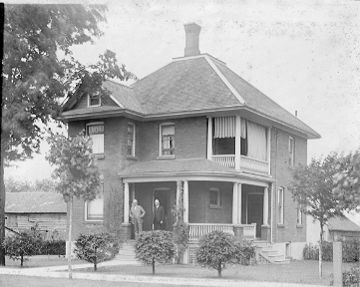
By 1914, S.H.’s three sons were settled on farms, his two eldest daughters were married, and he and Margaret were ready to retire to Kincardine. You can check out the house he had built at 806 Huron Terrace.
The barn you can see on the right was originally the house built for Great-great-grandpa Graham in Huron and moved to Kincardine by horse and manpower. There, Great-grandpa kept a cow, Leghorn hens and his horse and buggy which he drove while drawing the mail on the South Line of Kincardine Township. The mail was sorted in the loft above the stable.
When I still lived in Ontario. I used to see a buggy on display in front of the barn. I regret that I did not check out the origin of that buggy. [The building on the left was Albert Pollard’s blacksmith shop.]
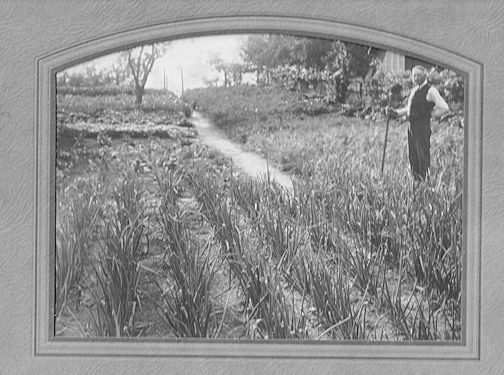
Retirement did not mean the cessation of farming. The garden behind the house was indeed a small “farm” with plots of vegetables and fruit all carefully laid out. Mum said woe-be-tide anyone who stepped off a path while visiting. There was a small stream at the top of the hill overlooking the lake where watercress grew. This was Grandpa’s garden in 1930.
S.H. was devoted to the Anglican Church of the Messiah as many Farrells have been. In 1929, when the first Parish Hall was built, he gave $500 to help alleviate the indebtedness, but on the condition that no one would play cards, dance or serve liquor in the building. [He himself loved to dance the “Corn On.”]
I wonder how many times he rolled over in his grave when the women’s groups began having card parties. His grandchildren were becoming old enough to spend the week in Kincardine while attending high school. He delighted in ushering half a dozen young folks into his pew at the front right hand post for Sunday Evening Prayer services.
Of the seven Farrell brothers, several had high receding hairlines. I’m not sure when it came to the point that Great-grandpa invested in a toupee. One of the older women at Messiah remembered the first Sunday he walked down the aisle and removed his overcoat and hat, revealing his new headwear. She said there was a collective gasp followed by a noticeable hush. Mum had never seen him without it.
Great-grandma died in 1923 from complications following a kick from the cow. Great-grandpa married twice more. In 1926, he married Ella Blair who had, apparently, worked at Lampman’s store, although her occupation is listed as nurse on the marriage licence. She was a member of one of the Blair families in Huron. A little more than a year later, she died while visiting her brother in Alberta. S.H. went out to Edmonton to accompany the body home.
Great-grandpa’s third wife was Isabelle Nicholson, also from Huron. A note says she was the first teacher at the Chickey School. I would like to check that out. Her brothers were United Church ministers; Rev. J.C. married my parents and baptized me at Bethel. I remember that she was called Aunt Belle. She and Great-grandpa enjoyed 12 years together before he died in 1946, a week before his 90th birthday.
The big red brick house was sold to Jack and Rita Reynolds who turned the lot into what is said to have been the first establishment to welcome tourists in Kincardine. It still serves this purpose. Check that out on Google.
April, 2022
Ruth Anne Hollands Robinson
 Written By
No bio for this author.




Related Stories
No related stories.