Seniors Matter(s): Treating low testosterone
I thought I was writing this for only half the population; then I quickly realized it affects both sexes!
My research gleaned that testosterone levels in men start to spike during puberty and drop on average by one per cent every year after age 30. Do the math!
Lack of this key sex hormone in older men can cause health issues, including osteoporosis, loss of muscle mass and strength (sarcopenia), and psychological symptoms. Doctors prescribe testosterone drugs to treat these symptoms.
While declining testosterone levels tend to be part of normal aging in men, others experience the dip because of disorders of the testicles, pituitary gland and brain that cause hypogonadism. Other factors — such as injury to the testicles, cancer treatments, chronic diseases, and stress — can also contribute to low testosterone production.
The United States Food and Drug Administration (
FDA) approved testosterone as replacement therapy only for men who have low testosterone levels due to disorders that cause hypogonadism. However, the agency has said testosterone is being widely used to try to relieve symptoms in men who have low testosterone for no apparent reason other than aging — a use for which the benefits and safety have not been established.
DECLINING TESTOSTERONE LEVELS BY AGE
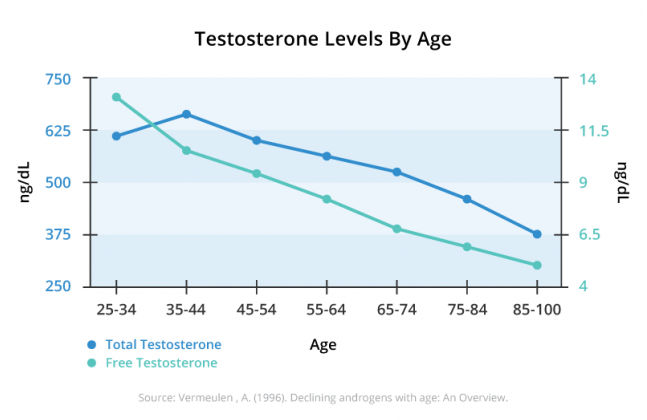
Doctors analyze testosterone levels in two categories: total testosterone and free testosterone. Most testosterone is attached to a protein called sex hormone-binding globulin (SHGB). A small amount of testosterone is free, and a small amount regularly attaches and detaches itself from a protein called albumin. Any testosterone that is not attached to SHGB is considered free testosterone.
Remedying erectile dysfunction
Some men turn to testosterone to increase sex drive and treat erectile dysfunction (ED), which is the inability to get and keep erections. In fact, according to an article published by Harvard Health Publications, some doctors used it to treat ED before
Pfizer released Viagra in 1998.
“It’s well established that testosterone, by itself, for men with sexual dysfunction that includes erectile dysfunction, can improve erections in the majority of men who take it.”
However, only about five per cent of men experience ED solely from low testosterone. Low testosterone levels can be a contributing factor to ED but are more likely to reduce sexual desire than cause ED. Many doctors won’t consider prescribing testosterone to a patient unless he presents certain other symptoms too.
Dr. Abraham Morgentaler is an advocate of using testosterone for treating men with sexual dysfunction, including ED. He does admit that some men may require testosterone and
Viagra, however, in order to have adequate erections.
Enhancing physical performance
Because testosterone allows men to increase muscle mass and performance, athletes and body-builders use testosterone-boosting supplements and drugs to increase strength and improve recovery time. The practice of using these drugs is called “doping.” Athletes use both synthetic and bio-identical supplements. Body-builders, in particular, are known for their use of synthetic hormones to rapidly increase muscle mass.
“Testosterone can help increase muscle mass in a much faster fashion. Athletes who use anabolic steroids may find that they’re able to increase their endurance and their strength by doing the same amount of training as they would otherwise,” said Dr. Anthony Yin, an endocrinologist at the California Pacific Medical Centre in San Francisco.
However, using performance-enhancing drugs, testosterone included, is illegal in most sports. While the drug is helpful to men who are clinically diagnosed with low testosterone, men who abuse these drugs solely to boost performance, face a number of possible side effects.
Critics and risks
As use of testosterone therapy has increased, so has the amount of concern surrounding these products.
Some doctors say that, in reality, few men are actually diagnosed with clinical hypogonadism, and that many “symptoms” are just a normal part of aging. A study published in the Journal of Clinical Endocrinology and Metabolism, shows record numbers of men in the U.S. are turning to testosterone therapy simply to increase their sex drive and energy levels.
Critics say that low testosterone is a condition
marketed by drug companies to increase profits. Doctors are concerned that the long-term effects have not yet been properly studied and feel there should be more agreement about what constitutes a normal testosterone level. Because testosterone therapies are not proven treatments, they caution that risks may outweigh benefits for
healthy men.
Dr. Lisa Schwartz, a professor at the Dartmouth Institute for Health Policy and Clinical Practice, wrote a paper on drug companies marketing these hormone therapies.
“We’re giving people hormones that we don’t know they need for a disease that we don’t know they have, and we don’t know if it’ll help them or harm them.”
Over the years, men have
sued the makers of testosterone products after using the therapies and suffering from heart attacks, strokes, and blood clots. Meanwhile, researchers have conducted studies to better understand the effects of testosterone therapy.
Caveat emptor!
As per my mandate, no animals were injured in the writing of this investigation.
‘Till next time!
 Written By
Bill Pike is a retired elementary school principal. He and his wife, Sharon, have lived in Kincardine for 47 years, enjoying fulfilling careers, rural life, three wonderful children, and four outstanding grandchildren. Golf in the summer (poorly), pickleball, guitar-playing, long leisurely walks, the sunny south and family all fill his time. This project is as an effort by him to share his interest about the topics affecting seniors and how they can advocate for their issues. The statement, “Getting old isn’t for the faint of heart,” is real! The rewards of retirement can sometimes be accompanied by aches, pains, medical concerns, and general wellness issues. In this column, Pike takes a look at the good, the bad, and the ugly of senior living. Don’t laugh at age, pray to make it!





Related Stories
No related stories.