



 July 22, 2022
3353
July 22, 2022
3353

He couldn’t drain Greenock Swamp, so Henry Cargill set hundreds of men to work digging canals and building roads. His goal was harvesting the vast stands of white pine, cedar, maple and elm growing deep in the swamp.
Back in 1871, Crown land in the swamp was going for $4.66 per acre. Cargill bought, and within eight years, owned most of the swamp. He began cutting trees on a grand scale.
First, his men wielded pick and shovel to dig canals to float logs to his sawmills on the Teeswater River. The muck piled along the canals formed ditch roads, used in winter to skid logs out on horse-drawn sleighs.
Cargill had 100 people logging the swamp, and another 200 in the sawmills. They worked 12 hours per day, six days per week.
The newspapers took notice. The “Port Elgin Times” of Feb. 14, 1895, reported, “The log business in Greenock Swamp is booming just now, about 100 men and 30 teams being employed there. Should the sleighing season last six weeks longer, it is estimated Messrs Cargill and Son will get about seven-million feet.” And indeed, during 25 years of operation Cargill cut down old-growth white pine at the rate of five-million board-feet per year.
In an interview with historian Bruce Krug, Alfred Garland of Brant Township said pine that was cut and milled at a cost of $6 per thousand board-feet, sold for $40 at the Cargill railway station. With profits like that, Cargill could well afford to build mills, dams, power plants and a village for his workers (Cargill, midway between Paisley and Walkerton). Cargill’s swamp empire made him the richest man in Bruce County.
What was life like in a lumber camp? John Bechberger of Walkerton can tell us. Interviewed by Krug in 1960, he remembered when his father, Joseph Bechberger, cut pine in the swamp around 1900.
“The men working in the bush were mostly from the Chepstow area while the men at the sawmill were mostly from Cargill. The men went into the swamp in October and remained there until the beginning of April. They stayed in bush camps and would come out to Chepstow on Sundays. The logging camp known as Camp No. 1, in operation from about 1900-10, was built of logs. There were double-deck wood bunks with straw for mattresses. Food was poor, being sow belly, potatoes and black-strap.
"The newer Camp No. 3 had a dining hall which held 50-55 men. Over the dining hall were the sleeping quarters with steel beds with springs and mattresses. Food was good. Beef and pork carcasses were brought in by farmers. There were lots of pies.”
And what do 100 lumberjacks do for entertainment on their day of rest? Krug found a story from an early writer describing a boxing match one Sunday afternoon, staged in a bush camp deep in the Greenock Swamp.
The contest pitted a tough Scot, “Black Jack” Macdonald, against the legendary French-Canadian, Jacques Lamarche, each in superb physical condition and each, undoubtedly, invincible. Two rival camps met to settle the issue.
Many of the crowd were fortified with liquor and in a fighting mood well before Lamarche and Macdonald entered the makeshift ring. Betting among the lumbermen was heavy as their champions took the ring, stripped to the waist. The rules were simple: 10-minute rounds, and the last man standing claimed a $50 purse.
With the boss-woodsman of a neighbouring camp as referee, the duel started with wary sparring. Then Macdonald stepped in closer and they exchanged blows. Lamarche feinted, and half-stooping, grasped Macdonald around the waist, throwing the Scot hard to the ground. Both turned over and over, wrestling. This got them nowhere and the referee stepped in and separated the pair.
In the second round, there was no pretense of sparring and the men exchanged hard blows. Macdonald’s face was marked badly and Lamarche had a cut below his right eye. As he was wiping his eye, Macdonald hit him hard on the chin. Lamarche fell flat on the ground and Macdonald rushed in to finish the fight.
Quick as a flash, up came Lamarche’s feet and there was a crash as his heels hit Macdonald’s chin. Lamarche was up then and as Macdonald was recovering from the shock, rained quick blows. Macdonald slumped to the ground. At that point, arguments over the purse of money broke out in the crowd, threatening a pitched battle.
The upshot of the Battle of the Swamp was that the lumber bosses of the district, and many settlers, expressed their disapproval of fighting for money on Sundays, so a notice was posted saying that any man caught fighting on Sunday would lose a half month’s pay.
Learn more about Henry Cargill’s swamp empire from Kevin McKague, author of “Henry Cargill: Bruce County’s Captain of Industry.” Meet him at Local Authors Night, Monday, Aug. 8, at 7 p.m., at the Bruce County Museum and Cultural Centre in Southampton. Also speaking, will be Dr. John C. Carter (“Piratical Doings on the River St. Clair”) and Robin Hilborn (“Joyce Hilborn”). The wine and cheese reception is hosted by the genealogical and historical societies of Bruce County.
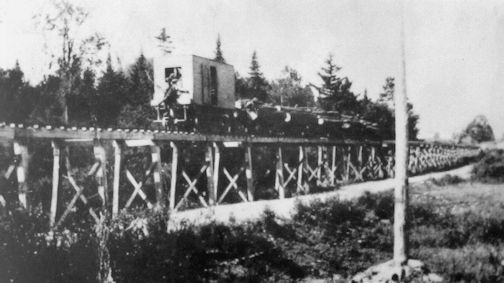
Henry Cargill’s son, W.D., built a narrow-gauge railway into Greenock Swamp but it kept sinking into the mire (Irwin Lobsinger)
Related Stories
No related stories.