Kincardine Residents Against Phragmites continue to fight invasive weed
Lake Huron’s water level is down, providing a perfect opportunity for the invasive weed, Phragmites, to once again dominate Kincardine’s shoreline.
Kincardine Residents Against Phragmites (KRAP) committee members have been monitoring the situation over the past two years.
During the COVID-19 pandemic, the higher lake levels assisted in plant management to better control the invasive species.
“Because of COVID-19 restrictions in 2020 and 2021, we were limited in the initiatives we could take,” said KRAP president Gail Walden. “But fortunately, due to the work we had accomplished in the years leading up to COVID-19 and because of the higher lake level, the situation was fairly easy to manage. So, the timing worked out well! But our work is far from complete.”
Phragmites has been popping up inland and can be seen in various locations around Kincardine, including the corner of Highways 9 and 21, at the Kincardine Golf Course and in several agricultural fields.
KRAP committee member Anita Heikkila said the group has shifted its focus from the beaches to areas inland where Phragmites appears to be spreading.
“It’s amazing how much of a problem we have right here in Kincardine,” she said. “In our experience, most people have seen it, but don’t realize that it is an invasive species.”
Phragmites is an invasive plant that first appeared in Canada in the early 1900s. The first specimens showed up in Ontario in the 1940s. Since then, the plant has become well-established and can be found all over Ontario, along 400 series highways and on many rural roads.
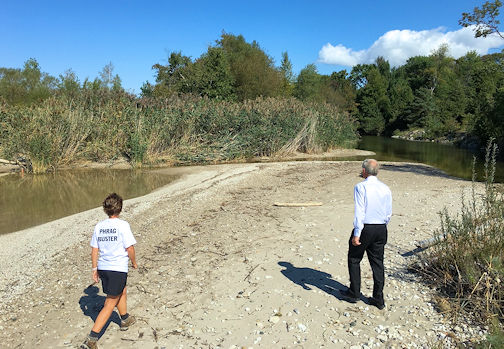 Phragmites can reach heights of five metres; this is a large stand of Phragmites located at Lorne Beach, summer of 2018; with Bill and Anita Heikkila; photos courtesy of Gail Walden
KRAP was formed in 2016 when Kincardine residents noticed a plant beginning to take over several of the beaches in Kincardine. Working closely with the Municipality of Kincardine, the group was able to identify the plant as Phragmites and organized volunteers to begin the process of controlling the plant.
With help from Dr. Janice Gilbert, a wetland ecologist, the municipality hired individuals to backpack-spray plants that were growing and well-established on dry land.
KRAP successfully applied for funding from Bruce Power, and purchased tools and hired students to physically remove the plant and rake it into piles for proper disposal by residents. Volunteers then burned the plants, and new growth was controlled using a spading technique that worked well.
In the past five years, the group has helped clean up and control Phragmites along the shoreline, from Boiler Beach to Lorne Beach, a distance of 16 kilometres. In the past two years, some of the plants were effectively drowned. However, in areas where Phragmites was growing in the water, the plants have now re-established growth on what is now dry land.
Committee members have met with residents to teach them what to do when plants begin re-appearing.
“It is much easier to eliminate Phragmites when caught in the early stages,” said KRAP committee member Marlene Morrow. “Because of the work we have accomplished in the past few years, working with residents, people are equipped to identify the problem and spade new plants as they appear.”
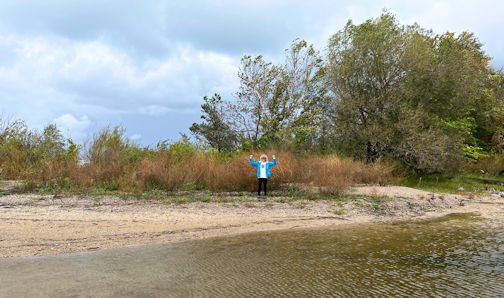 This picture, taken September, 2022, is the same area four years later, after being treated with an herbicide; natural plants have once again taken root along the shoreline; pictured is Marlene Morrow of KRAP
Bruce Power’s support has also allowed the group to reach out to people, to educate and inform them about the potential hazards and the detrimental effects this plant can have on property and on ecosystems, and to teach individuals how to control its spread.
“Prior to COVID-19, at a Cruise Night, we set up a display to help people identify and better understand the plant, and how it establishes itself,” said Heikkila. “We were actually shocked to hear that some people thought the plant was a beautiful ornamental grass and planted it in their backyards! By setting up these displays and talking to people, we hope to teach them about the spread of Phragmites so that they can join our efforts to effectively control its growth.”
She said one of KRAP’s goals is to inform as many people in the community as possible about Phragmites in order that the group has a better chance of eliminating it in the area.
Kincardine recreation director Karen Kieffer agreed that collaboration and partnerships are key to stopping the spread of Phragmites. Since 2013, the municipality has committed more than $260,000 to help eliminate the problem.
“We are extremely pleased with all the efforts shown to date with regards to the eradication of Phragmites along the lakeshore, as well as the dedication of volunteer groups, such as KRAP, and our many partners, including Ontario Power Generation (OPG), Bruce Power, the Lake Huron Centre for Coastal Conservation, Saugeen Valley Conservation Authority, etc.,” said Kieffer.
“The results have been positive, and our efforts will continue as our current Letter of Opinion from the Ontario Ministry of Natural Resources is valid until October, 2023, and post-COVID-19, the municipality plans to continue working with Gilbert, the Invasive Phragmites Control Centre and community volunteers to ensure we win the battle.”
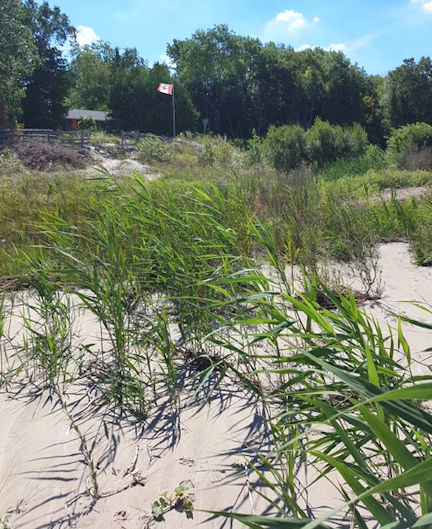 Phragmites growing on the beach at the base of Golf Links Road, summer of 2017
In 2023, KRAP intends to renew its education efforts and hopes to plan a public information session with the municipality, with the goal to once again raise awareness of Phragmites and its impact on the community of Kincardine and beyond.
Members of KRAP are asking residents to report stands of Phragmites to their group.
“We have identified many established stands of Phragmites but we know there are many more,” said Morrow. “Vigilance and diligence are key to ensuring that this plant stops spreading throughout our community in order that we can enjoy our beaches, protect our ecosystems, and keep Kincardine beautiful.”
If you see Phragmites on your property, contact Walden at
sgailwalden@gmail.com.
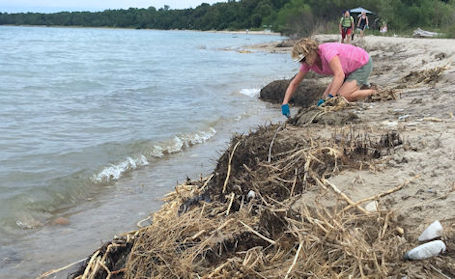
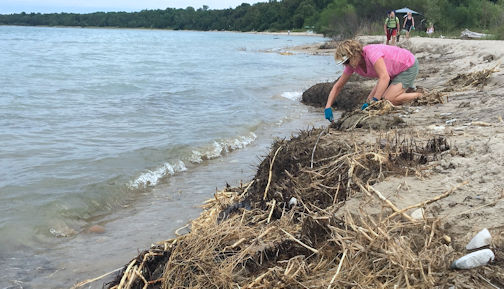 Marlene Morrow digs out Phragmites roots along the shoreline, July 2017
 Written By
No bio for this author.



Related Stories
No related stories.