Once Upon a Time: When Lake Huron split in two
One day, 10,000 years ago, hunters crouched behind boulders in the middle of Lake Huron, as a long line of caribou approached on their spring migration across the lake … the hunters’ winter famine would soon be over.
How was it possible to hunt caribou in mid-lake? University of Michigan archaeologist Dr. John O’Shea revealed the answer at a talk, Aug. 25, in in Point Clark.
For a few thousand years, the lake level was unusually low, so low that a narrow bridge of land appeared, splitting Lake Huron in two. Called the Alpena-Amberley Ridge, it connected North Point (near Alpena, Michigan) to Point Clark (near Amberley, Ontario).
This meant that you could walk across the middle of Lake Huron on a natural causeway 160 kilometres long and just a few kilometres across — wide enough for caribou to cross on their spring and fall migrations, and for hunters to lay in wait for them.
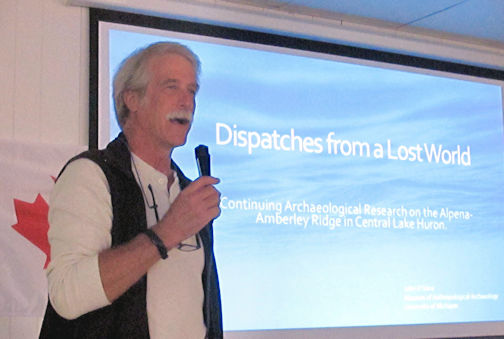 Dr. John O’Shea addresses a crowd of about 200 people in Point Clark; photos courtesy of Robin Hilborn
Before a packed hall of 200 at the Point Clark Community Centre, O'Shea showed his proof — photographs taken on dives to the ridge, now under 40 metres of water. Divers found evidence left behind by caribou hunters: hunting blinds and drive lanes constructed with boulders to funnel the animals for easier harvest. Recent dives have revealed a cervid tooth fragment, stone microblades, house rings and a central fireplace.
With the help of submersible vehicles, the Alpena-Amberley Ridge has steadily yielded its secrets to O'Shea and his dive team. They have found features on the ridge between 8,000 and 9,800 years old. A peat deposit, for example, dated to around 9,500 years ago.
In 2022, they retrieved samples from a bed of peat and a rooted cedar stump on the ridge. Radiocarbon-dating put them at about 9,000 years old. Remarkably, the samples came from a location predicted by a class of Alpena High School students. They used a virtual world model to predict likely spots where caribou would be found, in this case beside a river connecting two lakes. Ancient DNA from the peat is now under analysis to reveal what animals were there.
O'Shea concluded with a plea. Since he could explore only down to the Canadian border in mid-lake, he urged Canadian researchers to investigate the promising south half of the ridge.
Curator of Great Lakes Archaeology at the University of Michigan Museum of Anthropology, in Ann Arbor, Michigan, O’Shea received a B.A. in Anthropology from the University of Nebraska, a diploma in Prehistoric Archaeology from Oxford University, and a Ph.D. in Prehistoric Archaeology from Cambridge University. He has directed major digs in North America, Hungary, Romania and Serbia. He is also engaged in underwater archaeology, involving historic shipwrecks and submerged prehistoric sites.
He revealed his latest discoveries at a talk sponsored by the Bruce County Historical Society and titled, “Dispatches from a lost world: Continuing archaeological research on the Alpena-Amberley Ridge in central Lake Huron.”
Historical society president Dorne Fitzsimmons said the group was thrilled with the large turn-out for the talk by O’Shea. “The society is proud to be able to offer presentations such as this one to the community.”
O’Shea’s previous presentation to the historical society, “That Sinking Feeling: Archeology from the Great Plains to the Bottom of the Great Lakes," at the October, 2021, annual meeting, may be viewed on the society’s YouTube channel,
www.bit.ly/3tsnvDU.
At the next society annual meeting and dinner, Oct. 28, the featured talk will reveal how the old Douglas Point nuclear reactor will be dismantled and how its radioactive material will be handled. The meeting begins at noon at the Underwood Community Centre.
Tickets are $25 each for members and $30 each for non-members. For ticket, send an E-mail to
bchsregister@gmail.com or call 519-368-7186. The historical society welcomes new members and is seeking directors for its southeast and southwest divisions of Bruce County.
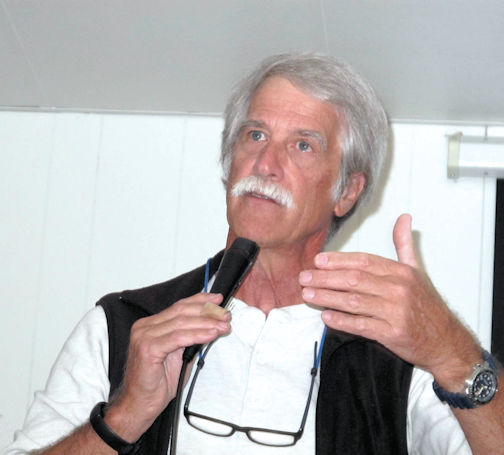 Dr. John O’Shea speaks about the Alpena-Amberley Ridge
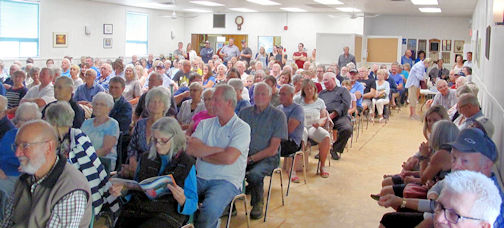 It took every chair in the Point Clark Community Centre to seat the 200 people who came to hear Dr. John O’Shea speak, Aug. 25
 Written By
No bio for this author.





Related Stories
No related stories.