Girls Hockey Memoirs, 1973-1977: A quest for recognition
Women’s hockey is now a major component of the Canadian sports scene, as we see the crowds at the Provincial Women’s Hockey League (PWHL) games and the recent International Ice Hockey Federation (IHHF) world championship.
It was not always that way. Locally, the “pioneers” of women’s hockey go back a half-century, to the Juvenile girls team that played in the Western Ontario Athletic Association (WOAA) in the mid-1970s.
John Gates coached that team for five years and has written the following “memoir” of the struggles and successes of these teenaged girls, including their WOAA championship wins in 1975 and 1976:
This is a story about a remarkable group of girls, who in the 1970s, wanted one thing – to play hockey and to be recognized as “hockey players.” I had the good fortune to coach these girls for five years.
Fifty years have passed since we started. Before memories fade and newspaper clippings are lost, it’s time to put pen to paper and tell their story.
Aside from perhaps having brothers who played hockey, the Summit Series 1972 was a big catalyst. The “national game” and national pride were on-the-line as these girls watched the eighth game at school and wondered, “Why only boys, why not us?”
The recreation director in Kincardine, Keith Davidson, became aware of this shortcoming in the town’s sports programs. He offered the girls ice time at the arena on Saturdays at noon - pay-as-you-play at the rate the boys pay - during November and December, 1972. The journey had begun.
1973
My involvement began in January, 1973, when a few girls from my classes at Kincardine District High School asked me to help on Saturdays. I agreed. Keith provided me with some ideas and drills and let me take over. Equipment was borrowed. A few had hockey skates. The girls played supervised shinny with a few skating drills.
That summer, I played fastball in Ripley. One of the players was Floyd Stanley, principal of the Ripley Elementary School. He had a similar girls hockey program operating the previous winter. We agreed to have a few games the next season. Importantly, via school contacts, Floyd knew about other towns with similar girls programs - unstructured, unorganized and unrecognized.
Later that summer, John and June Van Bastelaar of Port Elgin, organized a meeting for several “coaches.” We agreed to form an independent league for girls, ages 13-18. Teams were based in Port Elgin, Southampton, Paisley, Chesley, Tiverton, Kincardine, Hanover, Wiarton, and Wingham.
Floyd and I decided to amalgamate our players into a single team as there were not enough players in either Kincardine or Ripley for a full team. Keith arranged for a loan of unused goalie equipment and sweaters from the Kincardine Minor Hockey Association (KMHA), but the girls could not register with KMHA. We’d be an independent team. Nevertheless, the climb to respectability had taken another step – the girls had a team in “a league of their own.”
1973-74
Throughout the 1973-74 hockey season, practices for the team at the Lambton Street arena focused on skating drills. These drills were much easier now that all of the girls had hockey skates. The girls from Ripley had to drive to Kincardine for all games and practices.
The team played a 14-game schedule and was victorious at the year-end championship. The skating drills had paid off!
The players and parents paid for all expenses, although our meagre gate receipts did offset some of the costs. The girls purchased team jackets in orange with black trim (reverse of the KMHA boys jackets). Another rung had been climbed – the girls had their own “hockey jackets.”
Friday, March 22, 1974, the team played in its first organized “hockey tournament” in Port Elgin. I remember the day vividly (not the scores or the winners) but because the tournament was one day after my son was born. The next day, the girls brought flowers to my wife, Judy, in hospital as she was the “Team Mom.”
In the summer of 1974, three coaches, including myself, asked the WOAA to create a ladies hockey division, on par with its other sports – boys minor hockey, fastball, baseball and intermediate men’s hockey. The board of directors agreed; Juvenile girls hockey on a trial basis for one year. Another rung on the ladder to respectability had been climbed.
1974-75
Before the hockey season began, I approached the KMHA about allowing the girls to register. The answer was no; the girls would play another season as an independent team.
In the fall of 1974, I asked Ray Meldrum, a teaching colleague at the Kincardine high school, if the Lions Club would sponsor the girls team. Within a couple of weeks, we received an answer = YES! The team would receive 100-per-cent support: sweaters, socks, ice-time and referees. There was one proviso: the sweaters and socks must be Lions Club colours - purple with gold trim with the Lions logo on front. We quickly accepted. With their own uniforms and a sponsor, another rung up the ladder had been climbed.
The 1974-75 hockey season was a great success. The girls again played a 14-game schedule with the Lambton Street arena as home base. We even had a two-day over-nighter in Paisley due to closed roads after our game had finished!

The team won the first WOAA Ladies Hockey Championship, having defeated Chesley in the finals, two-games-to-one, with a great crowd of approximately 150 at the third game at home. A WOAA Champions crest could be added to their hockey jackets. The climb to respectability moved forward.
After the season, the local newspaper printed a full-page story about the team and its struggles. Candid comments from some of the players painted an accurate picture of the road blocks and barriers they faced, as well how much they enjoyed playing the game.
Later in the spring of 1975, the Ripley Minor Hockey Association (RMHA) asked us to move the team to Ripley as about half of the players were now from Ripley-Huron. The girls could register with the RMHA! They quickly agreed. Finally, they would receive official treatment equal to the boys rep teams. Another rung had been climbed.
1975-76
All games and practices for the 1975-76 hockey season were held at the new arena in Ripley. Buttee Construction donated sweaters. Nancy Regier joined the team as manager and liaison with the RMHA. After a successful regular season, the team defeated Paisley in the finals to win its second WOAA Championship.
After the season was over, the Kincardine recreation board became interested in having girls playing hockey in Kincardine, even though the team had moved to Ripley for the preceding season.
I was invited to a board meeting to outline the girls’ struggles. Keith was in attendance, and when asked why the KMHA was reluctant to register girls, he replied, “The KMHA was afraid if it opened the organization to girls, there wouldn’t be enough ice available.” Board member Dana Howald quickly retorted, “In other words, as long as there was enough time for boys; that’s very male chauvinistic.” Board chairman Julien Bayley suggested that the KMHA, Keith and I work out our differences. Nothing happened.
In the spring of 1976, the WOAA voted to have girls hockey as a full-member sport, with its own bylaws and rules, and a representative on the board of directors. I was elected as the ladies hockey rep on the WOAA board. The girls now had a voice at the table equal to the boys teams. Another rung had been climbed.
1976-77
The team had another successful season in 1976-77 in Ripley, finishing second in league play. There was not to be a “three-peat” as the team lost the WOAA finals in Belmore, in overtime, in the fifth and deciding game.
1977-78
I had stepped down after five years as coach. The team continued for the 1977-78 season in Ripley and then disbanded as core players were away at college or out-of-town in post-secondary jobs. Most of the players could play games only on weekends if they were able to come home and there were not enough younger girls coming up (no feeder system). With similar scenarios unfolding in many of the local towns, WOAA Ladies Hockey collapsed before the end of the decade.
Postscript
Fifteen years after the inaugural season for this team, the KMHA registered girls into its first girls hockey program.
Women’s hockey has come a long way since the early days in Kincardine and in hundreds of small communities spread across the country. The first IIHF World Women’s Championships in 1990, first Winter Olympic Games in 1998, and the PWHL in 2023. The pioneers for all of that progress were no different than the girls who played for Kincardine-Ripley between 1973-78.
In 30 years of coaching, this was the best team I ever coached - not because they had won three championships, but because of the players’ attitude. The girls’ willingness to learn, to always push harder on skating drills, to accept whatever challenges I placed before them – they responded with enthusiasm and determination. They wanted to practise hard and to learn. And learn they did – all while having fun and becoming “hockey players.”
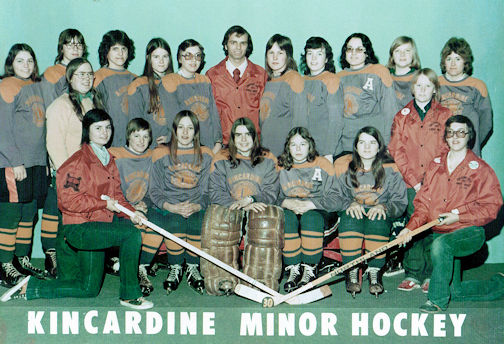 The Kincardine-Ripley women’s hockey team includes, in the back, Betty Ann (Shelton) MacArthur (left), Linda Pickles, Karen Fry, Alice Milne, Denise (Huber) Tews, coach John Gates, Shelley (Nace) Sayle, Jane Ann (Colling) MacDonald, Janice (Farrell) Miller, Christine (Bell) Gravel, Margie (Collins) Lochead; in the middle row, Mary Lynn MacLean (left), Joanne (Griffith) Little; and in front, Karen (Stewart) Kotva (left), Donna (Gallant) Skinner, Priscilla (Zipfel) Carruthers, Nancy (Kirkconnell) Stewart, Connie (Irwin) Zrini, Jocelyn Poirier, Donna (Huber) Tew; absent for the photo or played the previous year, Cathy (Pym) Alcombrack, Patti Bell, Gail Pretty, Laurie (Colling) Gallant, Laurie (Sutherland) Bellan, Laurie (Gottschalk) Pringle
Thank-you’s
- Keith Davidson – for starting the process in the fall of 1972 with ice-time at the Lambton Street arena
- Lions Club – for the sweaters and sponsorship
- RMHA – for accepting the girls into its program
- The two local newspapers for their coverage and stories and to my wife, Judy, for saving all of the articles
- Parents – who paid the bills and provided their daughters with the opportunity to play the game
- The players – who persevered, endured ridicule, and were dedicated and determined to pursue their dream of being respected as hockey players. The memories are amazing. I am proud to have been there with them on their journey.
2024
The eventual fruits of the team’s endeavours (and of other like-minded pioneers) can be seen on girls hockey championship banners hanging in arenas across the region. There must be a great feeling of pride for these former players, many of whom are grandmothers with grandchildren on the ice enjoying the game they fought so hard to play.
Personally, the pride surfaces while watching my own granddaughter on the ice with 30-plus other five- and six-year-old old girls who know nothing about the unequal treatment girls received two generations ago – a struggle for recognition and respectability that occurred across the country in the 1970s and early 1980s.
 Written By
Liz Dadson is the founder and editor of the Kincardine Record and has been in the news business since 1986.




Related Stories
No related stories.