Businessman offers historical account of Secord on eve of consultant’s report to Kincardine
Dan Showalter of Kincardine has a solid historical account about Dr. Solomon Secord that demonstrates his actions at the time he was serving in the southern United States, and why the people of the Town of Kincardine put up a monument in his honour.
And he wanted to share this information, as Kincardine council prepares to receive a consultant’s report about public engagement regarding the Secord monument.
Showalter’s brother-in-law, Mark Wenger lives in Virginia and is an historical architect. He has worked for Colonial Williamsburg and been involved in the restoration of many presidents’ houses.
Back in April, Wenger was visiting in Kincardine and he and Showalter began talking about the controversy surrounding the Secord monument.
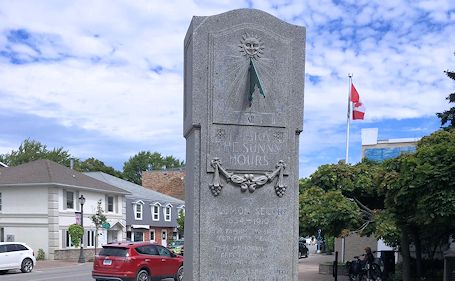
Last year, the Secord sundial monument was removed from in front of the Kincardine Library because Queen Street was being reconstructed. Due to concerns about a reference to Secord serving with the “Southern Army,” which is included in the inscription on the monument, council decided to bring in a third-party consultant to engage with the public and collect information before council made a decision about what to do with the monument.
Showalter said that Wenger discovered documents in the United States National Archives. One of these is a letter, written by Secord, Nov. 11, 1864, tendering his resignation as a surgeon in the Provisional Army of the C States.
The letter states: “I am a Canadian and came South on account of my health in December, 1860, intending to return as soon as it should be restored.
“I never intended to make my home in this Country nor have I received any of the Rights of Citizenship.
“I have never given up my allegiance to the British Government, nor have I by oath or otherwise rendered it to that of this Country.
“Finally, my health which had greatly improved, has for the last year been failing, and I much fear that my old disease (Consumption) is about to return.”
It is signed, “Very Respectfully, Your obt Servt, S Secord Surg, 20th Ga Regt.”
 Dr. Solomon Secord tenders his resignation in this letter; National Archives, Record Group 109
A second document, dated Nov. 15, 1864, written by Secord’s Lt. Col. E.M. Seago, states that he was not accepting Secord’s resignation for the following reasons:
“He is one of the most skillful attentive reliable Surgeons and Physicians I have known in or out of the Army, and I do not know where his place could be filled. If his health will permit I would much prefer that we could retain his services.
“If he is not able for service in the field I know of no man that could more Safely trusted in charge of a Hospital. He has been detached from the Regt for some time ... the Division Hospital, and I make this endorsement without his knowledge or consent.”
The information was sent up the chain of command, and finally, Nov. 22, 1864, acceptance of the resignation was recommended by W.H. Taylor for General Robert E. Lee.
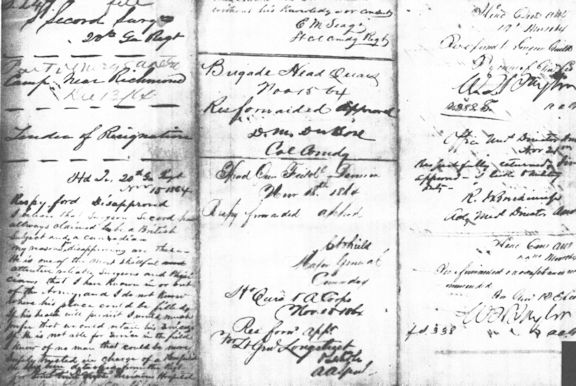 Secord's resignation is, ultimately, accepted by W.H. Taylor for General Robert E. Lee; National Archives, Record Group 109
“He was a Canadian and he wanted to go back to Canada,” said Showalter. “The people of Kincardine that he served, put up the monument in his honour. They didn’t do that for anybody else. He was such an asset to the community and the people responded in that way.”
Meanwhile, at the council meeting tomorrow night (July 24), Dr. Laura Mae Lindo, the facilitator for the public engagement process regarding the Secord monument, is providing a summary of what she heard throughout the first phase of the engagement process. To read her 78-page report,
click here.
 Written By
Liz Dadson is the founder and editor of the Kincardine Record and has been in the news business since 1986.




Related Stories
No related stories.