Kincardine Record
Banner Ad
Banner Ad

Bruce Power signs agreement to refurbish Units 3-8 at Bruce Nuclear site

Bruce Power communicationsBy: Bruce Power communications  December 3, 2015
Bruce Power signs agreement to refurbish Units 3-8 at Bruce Nuclear site

Bruce Power and the Independent Electricity System Operator (IESO) have entered into an amended, long-term agreement to secure 6,300 megawatts of electricity from the Bruce Nuclear site, through a multi-year investment program.

This gives the company the green light to refurbish Units 3-8 at the world's largest nuclear generator, located in the Municipality of Kincardine. And that means an investment of more than $13-billion and thousands of jobs for this area.
 

In 2005, Bruce Power signed the Bruce Power Refurbishment Implementation Agreement to enable the restart of Bruce A Units 1 and 2, in order to return the site to its full operating capacity of eight units. The amended agreement, signed Thursday (Dec. 3), will enable the company to progress with incremental life-extension investments, including refurbishment, to secure a clean, reliable and affordable source of electricity for Ontario families and businesses for decades to come, as outlined in Ontario’s 2013 Long-Term Energy Plan.
 

“Today is a major milestone in the history of Bruce Power as we build on our existing agreement with the province and extensive experience to enter the next phase of our site development,” said Duncan Hawthorne, Bruce Power’s president and chief executive officer (above). “This provides us the opportunity to secure our long-term role as a supplier of low-cost electricity by demonstrating we can successfully deliver this program incrementally.”
 

Over the past 14 years, Bruce Power has returned its eight-unit site to its full capacity, allowing Ontario to phase out coal-fired power generation, while providing low-cost, reliable and carbon-free electricity to families and businesses.
 

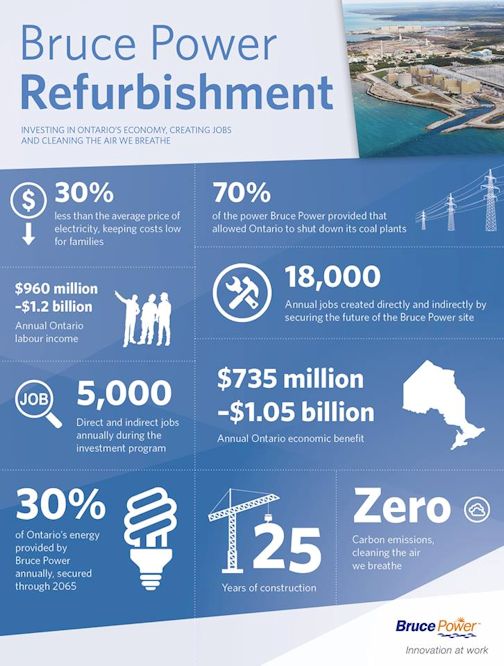
Bruce Power is Ontario’s lowest-cost source of nuclear, currently generating over 30 per cent of the province’s electricity at 30 per cent below the average residential cost of power. Extending the operational life of the Bruce Power units will ensure Ontario families and businesses have long-term price stability.
 

The amended agreement, which will take economic effect Jan. 1, 2016, will allow Bruce Power to immediately invest in life-extension activities for Units 3-8 to support a long-term refurbishment program that will commence on Unit 6 in 2020, optimizing the operational life of the site and offering significant ratepayer and system benefits.
 

“In the short-term, this amended agreement will allow us to establish the building blocks to be successful with our long-term program by investing to extend the operational life of the units prior to refurbishment, while also preparing for the first refurbishment, which will commence in 2020,” Hawthorne said. “This will set us up for success by allowing us to manage resources and facilitate a co-ordinated schedule to complete this program.”
 

Highlights of the arrangement include:
 

  • Jan. 1, 2016, Bruce Power will receive a single price for all output from the site of $65.73 per megawatt hour (MW/h). This compares to the current price paid to Bruce Power of $64.90 MW/h against an average price of residential electricity in the province to date in 2015 of $98.90 MW/h to the end of the third quarter (January 2015-September 2015).
  • Bruce Power, as a private sector operator, will continue to meet all investment requirements for the site. While there is a process to determine the cost of refurbishment and off-ramps, it is estimated the six refurbishments in the agreement will cost $8-billion (2014 dollars), in addition to $5-billion (2014 dollars) in a range of other life-extension activities from 2016-53. In the short-term, between 2016 and 2020, the company will be investing approximately $2.3-billion (2014 dollars) as part of this plan. This is incremental to the company’s ongoing financial investments to sustain eight units of operation.
  • The refurbishment of each unit will add approximately 30 to 35 years of operational life, while other life-extension investments will add a combined 30 reactor years of operational life to the units, pre-refurbishment. This approach provides additional benefit in terms of sequencing refurbishments and optimizing asset life.
  • Bruce Power will bear the risk of delivering these projects on time and on budget with upside sharing for better than planned performance with the IESO. The price of these refurbishments will be finalized prior to each project through a defined, transparent process in the agreement.
  • The agreement allows for Bruce Power to invest in the pre-planning of refurbishment activities, leading to greater predictability, which will lead to the successful delivery of the program. All of the future plant investment activities outlined in this agreement have been previously completed by Bruce Power over the past 14 years, and the company will build on these lessons learned moving forward. The price of electricity will be adjusted as funds are incrementally spent as part of the investment program.
  • The program will secure an estimated 18,000 jobs directly and indirectly from operations, and an additional 3,000-5,000 jobs annually throughout the investment program, injecting billions into Ontario’s economy as outlined in an Economic Impact Study, released in 2013.
  • Consistent with the long-term energy plan, a series of realistic off-ramps have been built into the agreement related to both refurbishment performance and if the province’s market conditions change.
  • Bruce Power will continue to provide approximately one-third of its output (2,400 MW) as flexible generation, allowing the province to permanently balance system needs in a post-coal environment. This is a feature that only the Bruce Power units can provide, and has been used frequently by the IESO since 2009.
  • As has been the case since 2001, Bruce Power will continue to assume responsibility for operating the site. In Canada, nuclear facilities are regulated by the federal government through the Canadian Nuclear Safety Commission (CNSC) and Bruce Power, as a licensee, will be responsible for meeting all regulatory requirements and gaining the necessary approvals to implement the investment program. The refurbishment timetable is consistent with Bruce Power’s current site licence that runs to 2020, which assumes there will be no refurbishment within this period. The CNSC licensing process is an open, transparent process that provides the opportunity for public, community and Aboriginal engagement, and, consistent with past practice, Bruce Power will start the external engagement as part of this process in 2016.


The Bruce Power Refurbishment Implementation Agreement has been available to the public since it was first signed in 2005, and the company and the province continue to support this open and transparent approach. The agreement, along with other background materials, has been made available on the company’s website.
 

Bruce Power currently has two different partnership structures – Bruce A LP (Bruce A) and Bruce Power LP (Bruce B). As a result of Thursday's transaction, Bruce Power will move to a single partnership structure through Bruce Power L.P.
 

TransCanada Corporation (TransCanada) has also announced it intends to exercise its option to acquire an additional interest in Bruce Power for $236-million from the Ontario Municipal Employees Retirement System (OMERS). TransCanada and OMERS will each hold a 48.5 per cent interest in Bruce Power, with the remainder held by the Power Workers’ Union, The Society of Energy Professionals and a Bruce Power Employee Trust.

Related Stories

No related stories.

Share

    Comments (0)

  1. No Comments.

Leave a Comment

By submitting this form, I consent that my name (and email, if provided) will be published on kincardinerecord.com as part of this story.


Banner Ad
Banner Ad