Once Upon a Time: Finding “Africa” in Lake Huron - a shipwreck revealed
When the husband-and-wife film-making team, Zach Melnick and Yvonne Drebert, was planning its latest film, discovering a 128-year-old shipwreck off the Bruce Peninsula wasn’t part of the script. But that’s what happened in June, 2023.
Yvonne and Zach found the wreck while filming “All Too Clear: Beneath the Surface of the Great Lakes.” It’s about the invasion of quagga mussels which have devastated underwater life in the lakes.
The quagga mussel and its smaller cousin, the zebra mussel, come from lakes in southern Russia and Ukraine. They arrived here when ships dumped their ballast water into the lakes and set free the invaders.
When it spawns, a female quagga mussel releases up to a million eggs, though most die. Forming vast underwater colonies, the mussels feed by filtering plankton and other nutrients out of the water. This depletes the food of native species, impacting the entire food chain, from plankton to the largest fish.
The mussels have the side effect of removing suspended particles and making lake water clearer than it’s ever been — a boon for underwater photographers.
As Zach explained, “The film talks about the tremendous eco-system change that’s happened in the off-shore waters of the Great Lakes because of quadrillions of invasive quagga mussels that almost no one sees, and which have fundamentally changed how these lakes work, resulting in huge declines in fish species.”
The co-owners of Inspired Planet Productions spent more than 150 days criss-crossing the lakes with a remotely-operated vehicle made by New Zealand’s Boxfish Robotics. It allows cinematographers to film underwater from the safety of their boat, via a 200-metre fibre-optic tether.
From his onboard console, Zach can monitor the view underwater and steer the camera in any direction. He and Yvonne have amassed a vast archive of footage, documenting the behaviour of fish in the Great Lakes, including the first known recording of lake whitefish spawning in the wild.
In June, 2023, during the filming of “All Too Clear,” their underwater drone turned up a surprise. “We actually found quite a significant shipwreck in Lake Huron, which was a ship called the ‘Africa,’ and it went down in 1895,” says Zach. “Eleven people died when it went down, and it was through the process of making this movie that we found this thing — 80-85 metres down in the middle of Lake Huron — that really ignited a huge amount of interest in this production.”
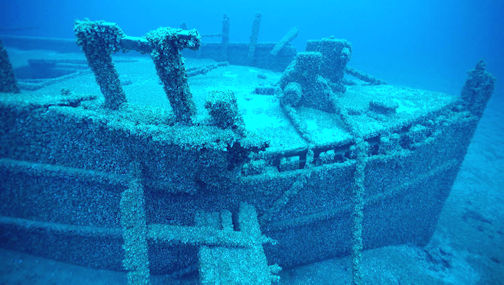 The “Africa” on the lake bottom, entombed in quagga mussels; photo courtesy of Inspired Planet Productions
How did they find the shipwreck? While they worked on the documentary, a source at the United States Geological Survey told them of sighting a mound on the otherwise flat bottom of Lake Huron, possibly a rock formation. They navigated to the spot and dropped the drone 85 metres to the bottom.
When the mound came into view, Zach’s screen displayed the hull of a large wooden ship, almost perfectly intact in the crystal-clear water. The shells of quagga mussels encrusted the entire hull, including the name plate, making it unreadable.
The story of the “Africa” is well told in the 1997 booklet, “Shipwrecked on the Bruce Coast: Eleven lives lost in tragic Lake Huron disaster,” by Captain Gerry Ouderkirk.
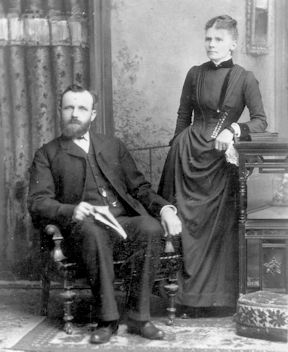
In October, 1895, the “Africa” was carrying a load of coal from Ashtabula, Ohio, to Owen Sound when she encountered a gale and disappeared beneath the waves. Eleven people perished when she sank, including Captain Hans Larsen. Nearby Larsen’s Cove, on the west coast of the Bruce Peninsula, was named after him and is, coincidentally, where Yvonne and Zach live.
“
Africa” captain Hans Larsen (left) and his wife, Jane
To foil bounty hunters, the wreck’s location has not been revealed but it is mid-lake, off Lyal Island. It’s a registered marine archeological site under the Ontario Heritage Act and, therefore, protected from scavenging. Anyone tampering with the site could be fined up to $1-million or go to prison for a year — which means the name plate cannot be scraped clean of its embedded quagga mussels to confirm the ship’s identity.
Nov. 2, Yvonne Drebert and Zach Melnick will tell the whole story of finding the long-lost “Africa.” They’ll speak at the annual meeting of the Bruce County Historical Society, at noon, in The Meeting Place (Wiarton Propeller Club), Wiarton. Buy your ticket ($30, with dinner) by Oct. 25 by sending an E-mail message to
bchsregister@gmail.com or calling 519-368-7186. Details are at the historical society’s website,
www.brucecountyhistory.on.ca, and Facebook page.
Yvonne and Zach have now released “All Too Clear,” with its spectacular scenes of “Africa” intact on the lake floor. It will be broadcast in three parts on TVOntario, starting Oct. 26 at 7 p.m., and streamed on
www.tvo.org. TVO was also where the film-making duo debuted, in 2018, the three-hour history of Bruce County, “The Bruce,” in a collaboration with the Bruce County Historical Society.
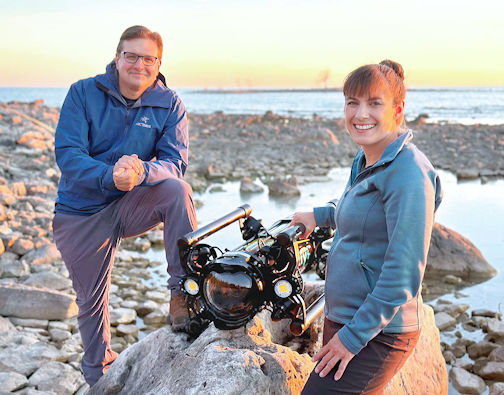 Zach Melnick (left) and Yvonne Drebert with their underwater robot, Kiyi; photo by Esme Batten
 Written By
No bio for this author.





Related Stories
No related stories.