Kincardine council moves ahead with low-income building in downtown core
To the Editor:
Re: “No to Transient Housing in Town Core”
At the Kincardine council meeting Nov. 13, the motion was passed to sever and re-zone part of the parking lot behind 705 Princes Street; with an intent to build a 34-room low- (or no-)income building.
This property is currently leased by the Bruce Power Training Centre. The parking lot is used by the centre on weekdays, and by nearly all downtown events at various other times. There was no public input to this decision.
Apologies for another lengthy letter, but there is so much to unpack here:
- Council is there to represent municipal ratepayers. Potential future tenants are not ratepayers.
- The parking lot is not “unused.” Below, are photos of the number of cars attending training this week (two random mornings in November, plus a Friday evening. It is not even tourist season). Perhaps council doesn’t mind forcing the Scottish Festival and other large events to find a more accommodating host. Kincardine already has a core area parking shortage. (In fact, during the same meeting Wednesday night, council voted to limit Queen Street parking to three-hour periods, beginning April 1, 2025).
- The Flourish report put the value of the lot to be severed at $1-million. The municipality intends to donate it toward this project. With zero public input.
- Even if council pretends this parking lot is expendable, it is still a big mistake to put such housing in Kincardine’s core. This could cause serious negative repercussions to the municipality for decades to come.
- The public completely understands that the homeless situation in Canada has worsened since the COVID-19 pandemic, and everyone agrees that more housing is needed. However, as R.P. Plater correctly pointed out in a letter, posted Nov. 12 (Kincardine Record), it is not the mandate of local municipalities to provide affordable housing. Councillor Bill Stewart also stated that it is the duty of Bruce County council (not municipal council) to look after affordable housing.
- If council insists it needs to encourage “someone” to build “something,” then fine, but build it where the space is completely unused. There is plenty around. Again – the entire unused back and side of Connaught Park. Or the municipality could do its duty to perform any necessary Environmental Assessments and clean up the huge, empty field beside Elgin Market Pubic School. Or build it out by No Frills or Sobeys, so tenants could easily walk for groceries. Or take another look at the other lands that were identified in the Flourish report. It’s not as though there are no other options.
- Several councillors recused themselves from the discussion and vote, on the grounds that they (or their spouse) were employed by Bruce Power. The fact that Bruce Power is the current tenant using the school and parking lot has zero impact on them as Bruce Power employees – unless, of course, they are related to the person making any leasing decisions. This could be seen as a complete cop-out on the part of these councillors, but more likely, they recognize a bad idea when they see one, and don’t want to be any part of it. Smart.
- The vote went like this: councillor Mike Hinchberger, deputy mayor Andrea Clarke, councillor Rory Cavanagh and mayor Kenneth Craig voted for the motion to sever and rezone the parking lot. Stewart voted against it. The motion carried.
The upshot is – four individuals (who I’m sure are very well-intentioned but very misguided) voted for this to move forward. To this day, there has been zero public consultation or input on this decision.
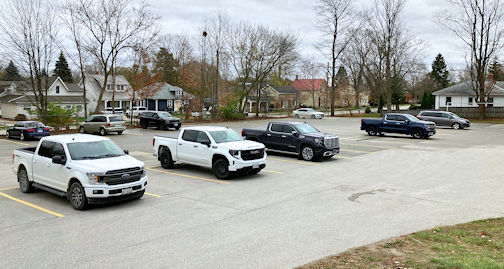 The Bruce Power Training Centre parking lot looking from the west
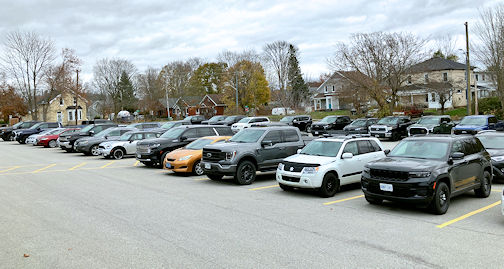
The Bruce Power Training Centre parking lot Monday morning
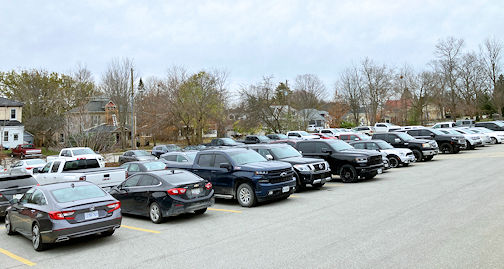
The Bruce Power Training Centre Thursday morning
Now, on to the other main problems with this proposal.
PROPOSED INDWELL/FLOURISH HOUSING PROJECT – RATEPAYERS DESERVE INPUT – AND ANSWERS
- The Flourish proposal shows 34 tiny studio units with support infrastructure (commercial kitchen, large dining room, a meeting room, a lounge, and two offices). Such a set-up may well work in a large city core, where there is public transportation to get tenants to jobs and groceries, and they do get vulnerable people off city streets. Kincardine has neither public transportation, 34 jobs (especially full-time ones) available near downtown, nor a grocery store nearby.
- Supposedly, the blueprint in the Indwell/Flourish report (quietly accepted by council, Oct. 23) is “just an example” of what Kincardine might want. It is based on what Indwell built in Woodstock. Here is a description quoted from Organization Indwell: Blossom Park of that Woodstock development: “Service Description: *27 independent apartments and 34-unit accessible apartment building *on-site nursing, housing, psychosocial and [addiction] support, and food security available seven days per week *on-call support available 24 hours a day, seven days a week. Application: no referral required.
Eligibility/Target Population: Adults living with mental health and addiction diagnosis in need of affordable housing with supports.”
- The use of the word “accessible” does not mean nice wide hallways, ramps and elevators. Instead, it indicates housing for people who find it difficult to access housing of any kind.
- The report gives a further recommendation to convert the former W.E. Thompson Public School building, itself, and perhaps, eventually, the green space around it (across from Victoria Park). Of course, the Flourish report says, “A more detailed study needs to be conducted to assess the feasibility and unit potential of the former school.”
- This 34-unit idea is the thin edge of the wedge. Besides filling up the rest of the downtown school property with an unknown number of low-income units, the report proposes (on private land at the southeast corner of the Municipality of Kincardine) “three blocks of apartments up to eight stories and 90 units per building.” Even if not all of these would be for unhoused people, how big is our local problem? Social services would, of course, know more accurate numbers. Perhaps they could share that information. Or are we planning to import people from other towns or even Toronto? Build it and they will come?
- The current 34-unit blueprint shows no room for cots or cribs, but mention was made that perhaps some of the units could be made larger, actual one- or two-bedroom units, to be used by women moving out of the Women’s House shelter. Would there then be security provided for these vulnerable residents? Or would the police be attending at regular intervals?
- Mention was further made of some of the spaces being used for low-income seniors. There is just as big a shortage of spaces for seniors in Kincardine as there is for unhoused people. Sadly, two beautiful core area senior homes shut down years ago, replaced by boarding houses largely for out-of-town contract workers, that needed – you guessed it – more parking. Why does council not do more to support these long-time residents (and ratepayers) who would love to be able to have a retirement residence so they could remain in their own town as they age?
- It is doubtful, however, that a vulnerable senior or Women’s House graduate would be happy sharing living space with the rest of the intended residents.
C. Brown
Kincardine
P.S.: I do a disservice when I keep mentioning “council” throughout. In fact, only four people voted for this. The rest of the councillors, I’m sure, are striving to do their best to do their jobs and properly represent their ratepayers.
 Written By
No bio for this author.






Related Stories
No related stories.