Secord family upset over destruction of monument by Municipality of Kincardine
David Secord of Calgary, Alberta, is heartbroken that the monument to Dr. Solomon Secord, which sat in downtown Kincardine for over a century, has been destroyed.
Kincardine council made the decision Sept. 11, to “decommission” the monument, and it was destroyed six days later.
Representing the Secord family, David Secord told the Kincardine Record in an exclusive interview, that the family was not even aware of the controversy surrounding the monument until Sept. 13.
“I happened to be doing some research about our family and saw your
news story indicating the monument was to be destroyed,” he said.
He called the Municipality of Kincardine, Sept. 13, and left a message with the secretary for mayor Kenneth Craig.
“I left the message with the mayor’s secretary, who answered the call, that I represented the Secord family and wanted the Dr. Secord Monument to be returned to the family and not to be destroyed, and I was told I would receive a call back. I never did receive a call back.”
Secord said he heard nothing from the municipality so he had his lawyer send a letter, Sept. 23, to the mayor, deputy mayor and all the municipal councillors and the municipal CAO (chief administrative officer), again requesting that they do not harm the monument and that they return it to the family as he had not heard back from the municipality.
He said the municipality’s legal counsel advised the Secord family, Sept. 24, that it had received the letter, dated Sept. 23, and would provide a response within the next week.
“We never heard anything from the legal counsel or the municipality the following week,” said Secord. “Oct. 8, we reached out to the municipality’s legal counsel, requesting a response and, again, no reply. Oct. 11, again, we reached out to the municipality’s legal counsel.
“Oct. 15, the municipality’s legal counsel advised us that the monument was decommissioned Sept. 17, but did not confirm if that meant destroyed or disposed of in some other way.
“Oct. 24, the municipality’s legal counsel finally confirmed in an E-mail that the monument had been destroyed Sept. 17.”
Among the many questions he has for the municipality, Secord wants to know why it took a month to tell the family that the monument had been destroyed.
He said no one from the municipality ever contacted the family to ask whether it wanted the monument returned, once the decision was made not to return it to its downtown location.
Secord said the family is reviewing its legal options, given that the monument has been destroyed.
“We are questioning when exactly the monument was destroyed, as there are conflicting reports on whether it was destroyed before or after Sept. 23,” he said.
When asked about next steps in this legal action, Secord said, “We have started the process of having the monument rebuilt, and it would be rebuilt exactly the same way it was before it was destroyed.
“At no time did the family ever object to the removal of the monument. We respect the democratic process and the taxpayers’ right to decide what they want and do not want in their community today. In fact, I’m sure Dr. Secord would not have objected.
“However, what we do object to is that council did not have the right to destroy a piece of private property that was entrusted to the municipality and has been in its safekeeping for more than 100 years, without consulting with the family first.”
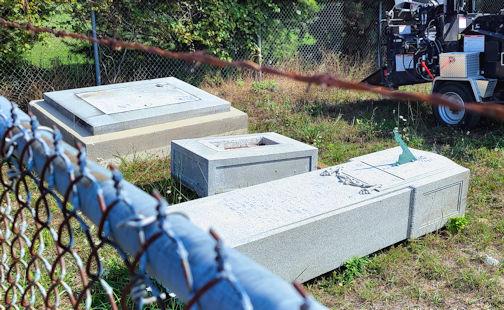 The Dr. Solomon Secord sundial Monument last seen behind a locked fence, across from the Ward 1 public works shed in Kincardine
DAVID SECORD’S CONNECTION TO DR. SOLOMON SECORD
The Dr. Solomon Secord sundial Monument last seen behind a locked fence, across from the Ward 1 public works shed in Kincardine
DAVID SECORD’S CONNECTION TO DR. SOLOMON SECORD
Dr. Solomon Secord is David’s great-great-great-great-uncle.
“My great-grandfather knew him,” said David. “He kept in touch with the family, and I heard from my grandfather all about Dr. Secord and the work he did in Kincardine, Ontario, and in the United States during the American Civil War.”
Dr. Secord’s great-great-grandfather, lieutenant Solomon Edwin Secord, and David’s great-great-great-great-grandfather, sergeant Stephen Secord, were brothers living in Westchester County, New York, in the late 1770s.
Sometime around 1776, at the outbreak of the American Revolution, because they chose to renounce the surging tide of revolution and remain among the most loyal British subjects, they and their families were forced to flee on foot with whatever they could carry, from New Rochelle, Winchester, New York, to Fort Niagara, Ontario, Canada.
They fought against the Americans during the revolution and were recognized as United Empire Loyalists. Even though many families split in their loyalties during the war years, many Loyalists in Canada continued to maintain close ties with relatives in the United States.
Dr. Solomon Secord was born in 1832 to George Osmond Secord, the son of lieutenant Solomon Edwin Secord. Richard Henry Secord, David’s great-grandfather, was born in 1860 to James Secord, the grandson of sergeant Stephen Secord.
In 1881, Richard Henry Secord moved west to Fort Edmonton. The families remained in contact with each other over many years. Both Richard Henry Secord and Dr. Solomon Secord were grand-nephews of Laura Secord.
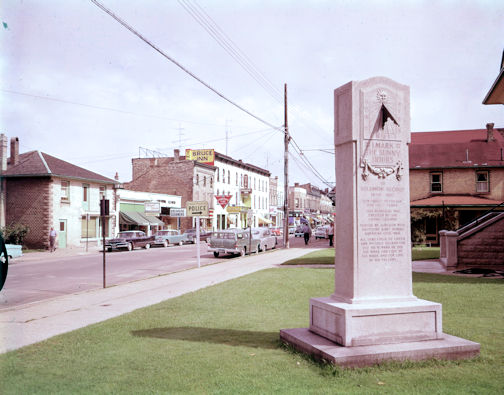 The Dr. Solomon Secord Monument in downtown Kincardine in the 1950s
As to Dr. Solomon Secord’s work during the American Civil War, David Secord refers to information from the National Museum of Civil War Medicine – “Unconditional Release:” Dr. Hunter McGuire’s Precedent in American Military Medicine,
www.civilwarmed.org/winchester-accord:
Winchester, Virginia, had been an operations base for the Union Army in the spring of 1862, and by May, well-furnished military hospitals received wounded from battles in the Shenandoah Valley. About 700 hundred patients rested in the Union hospitals, and as the Confederates approached, seven surgeons elected to stay with their patients.
That day, the Town of Winchester stood at the literal crossroads of history. Militarily, it occupied a significant turning point in general Thomas Jackson’s Campaign. Socially, it liberated the mostly pro-Southern town from “Yankee” rule. Medically, it presented an opportunity to help define how captured military doctors and nurses should be treated, ensuring more consistent care for the sick and injured.
Alerted to the plight of the captured Union surgeons, Dr. Hunter McGuire discussed the situation with general Thomas J. Jackson. They decided to set a precedent, hoping the U.S. government and Union military would follow the example and ease the situation for captured surgeons on both sides. The document McGuire prepared seemed reasonable to the seven Union doctors and they instantly signed the agreement.
Winchester, Virginia, May 31, 1862, “We surgeons and assistant surgeons, United States Army, now prisoners of war in this place, do give our parole of honour on being unconditionally released to report in person, singly or collectively, to the Secretary of War in Washington City as such, and that we will use our best efforts that the same number of medical officers of the Confederate States Army now prisoners or may hereafter be taken, be released on the same terms. And furthermore, we will on our honour use our best efforts to have this principle established – the unconditional release of all medical officers taken prisoners of war hereafter.”
The agreement successfully introduced and pushed forward the idea with military commanders and the United States and Confederate governments that medical personnel should be treated as non-combatants and released as soon as possible to continue their lifesaving work. The results were almost immediately.
June 6, 1862, U.S. Secretary of War Edwin Stanton issued Special Orders No. 60 which “immediately and unconditionally” freed all Confederate doctors held prisoner. Robert E. Lee and George B. McClellan communicated officially regarding the release of captured doctors, and this became the rule regarding prisoner doctors, assistants, and nurses throughout the remainder of the Civil War.
DR. SOLOMON SECORD WAS A GREAT HEALER AND HUMANITARIAN
“Perhaps Kincardine councillor Mike Hinchberger, the mayor, deputy mayor and the rest of the council should have dug a little deeper and they would have found out that Dr. Solomon Secord did not escape in 1863 but was released by the Union to go back to the Confederacy so he could continue saving lives on the battlefield just as Union doctors were being released by the Confederacy,” said David Secord.
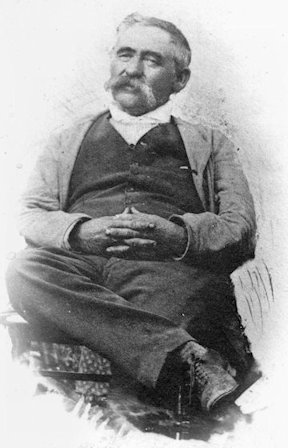
“They would have discovered that
Dr. Solomon Secord (right) and all the other doctors and nurses in the Civil War were deemed noncombatants and received unconditional releases; that there was mutual agreement between both sides during the Civil War that with the safety and quick release of doctors, assistants, and nurses ensured, care of the wounded progressed. And considering the earlier days when wounded were slaughtered as they lay helpless on the fighting fields, this revolutionized battlefield medicine by humanizing the battlefield and giving injured men a better chance to receive the care they needed to survive.
“And that following the Civil War, Confederate surgeon Hunter McGuire received credit for introducing the idea of classing medical personnel as noncombatants and that the idea eventually became part of the Geneva Conventions and a foundational principle upheld by the American Red Cross and the International Committee of the Red Cross.
“Through the eyes of our family, Dr. Solomon Secord was a great healer and humanitarian, a man of deep convictions with a strong moral compass, a sense of humanity, and a dedication to equality, knowledge, freedom, and unbiased patriotism, and who saved thousands of lives.
“Dr. Secord was a noncombatant in a war that even today continues to animate and divide people along racial, cultural, and ethnic lines. Everything rebounds to the ever-present elephant in the room — race. White people are in a constant state of denial about race and Black people are in a constant state of grievance about what was done to them in the past. The tension exists, and it has to be acknowledged and dealt with through honest and thoughtful dialogue.
“Taking down monuments is not going to improve that relationship. It only hardens feelings and causes people of goodwill to talk past each other, rather than talk to each other. We cannot change history, but we can learn from history — even history that offends us.
“Destroying cultural heritage is an attack on humanity’s past and present. Cultural heritage is what makes us human. It gives us a sense of place, and identity. It is kept in place to explain and explore a common human past – what makes us the same. We cannot do that if cultural heritage is destroyed, or worse, deliberately targeted.
“Destruction of cultural heritage is also an attack on us and our fundamental rights by some people who like to act like victims to create a situation. There are people like that in this world and it’s called gas-lighting, and I am sure you know people who do that - a few people in power who want to gas-light an agenda so they can stake out their positions and impose those positions and their will on others.
“The Dr. Solomon Secord Monument fell victim to American Civil War gas-lighting. Conscious bias and prejudices perpetrated that distorted the situation beyond the reality of what it really was, and then thoughtless actions were taken without consideration to all the facts.
“Military physicians, nurses, and other health-care professionals have served with courage in the theatres of war since Hippocrates and Galen laid foundational medical principles, and military leaders recognized the necessity of organized medical care on the battlefield. Some have received serious wounds, and some have died in the line of duty. By most accounts, they have delivered superb care to all soldiers, enemy combatants, and wounded civilians, alike. We owe them our gratitude and respect. We should affirm their honour, not destroy it, by acknowledging the tensions between their Hippocratic oath and national service commitments.
“Throughout military history, significant wars have catalyzed substantial advancements in military medicine and exposed the limitations of existing medical practices and prompted innovations in care for injured soldiers. In the American Civil War, the need for efficient casualty management led to the establishment of the first triage systems, which prioritized treatment based on injury severity. This approach significantly reduced mortality rates and reshaped battlefield medical strategies in subsequent conflicts.
“In the American Civil War, the American Red Cross was established, highlighting the importance of organized medical assistance for soldiers and was vital in setting standards for military medical care. American Civil War battlefield injuries necessitated rapid and effective surgical interventions, leading to innovations that shape modern surgical practices today. During the American Civil War, the implementation of anesthesia significantly changed the way surgeries were performed on injured soldiers.
“The journey of military medicine throughout history reflects a dynamic interplay of innovation and necessity. Each conflict has shaped advancements that not only benefited soldiers but also advanced public health and medical practices worldwide. From pioneering surgical techniques to the integration of technology, these contributions continue to influence modern health care.
“Understanding military medicine in history reveals its critical role in shaping both war and peace. The lessons learned and advancements made, serve as a testament to human resilience and the unwavering commitment of doctors to preserve life in the face of adversity.
“We owe all the doctors, nurses, and health-care workers our gratitude and respect. We should be acknowledging and affirming their honour, not destroying it, especially acknowledging the tensions between their Hippocratic oath and the national service commitments, and by continuing to work with them to map a course between the two.”
The Kincardine council meeting agenda for Wednesday, Nov. 27, includes the following item under closed session: Litigation or potential litigation, including matters before administrative tribunal, affecting the municipality or local board and advice that is subject to solicitor-client privilege, including communications necessary for that purpose (Potential Litigation Update - Secord Monument).
Kincardine council has yet to discuss any of the Secord family’s concerns in open session.
 Written By
Liz Dadson is the founder and editor of the Kincardine Record and has been in the news business since 1986.





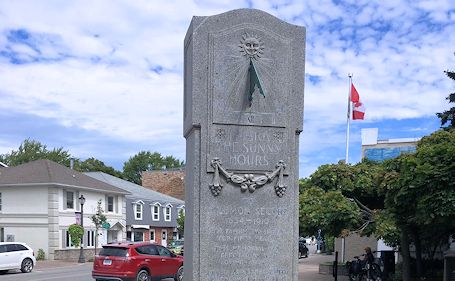
Related Stories
No related stories.