


 December 17, 2015
1473
December 17, 2015
1473

A long-time supporter of the nuclear industry, former prime minister Jean Chretien took his first tour of the Bruce Nuclear site, Wednesday afternoon (Dec. 16), and was quite impressed with it.
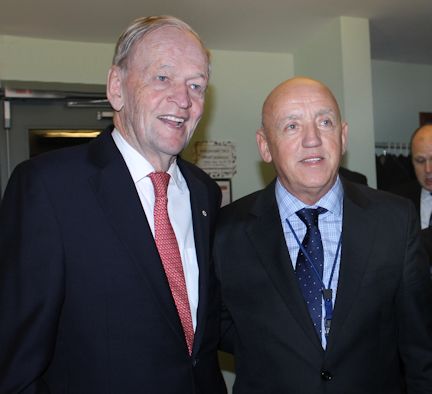
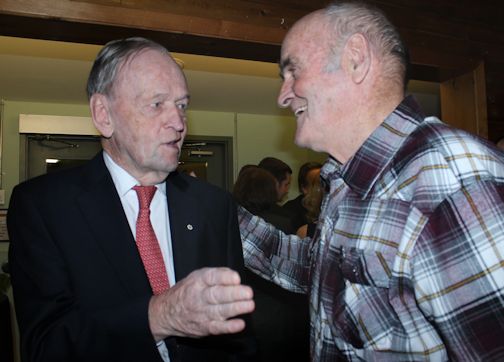
Guest speaker at Bruce Power's dinner to mark the completion of the Operational Safety Review Team (OSART) Mission, held at the Kincardine Pavilion, Chretien said it was an honour to visit the world's largest operating nuclear generating facility and to share in this special occasion with the community and Bruce Power employees. He was also impressed with the commitment to continuous improvement at the plant.
“As prime minister, I was always proud of Canada's nuclear industry and the role it plays at home and abroad,” he said. “This review demonstrates our openness and willingness to contribute to safety improvements in the international nuclear community.”
Talking to local media prior to the dinner, Chretien was enthusiastic about his first visit to the Bruce Nuclear generating station. “It's very big,” he said, noting that there are dangers to nuclear reactors, but only if they are not managed properly.
Former prime minister Jean Chretien speaking to local media at the Kincardine Pavilion, Wednesday night
“People are afraid of what they don't understand,” he said. “And that fear breeds fear in the community.”
As for the long-term management of used fuel, he joked that it takes thousands of years to reduce the spent fuel to a safe level. “I won't be here, so that's a problem for future Canadians to solve.”
During his speech to the crowd, following the dinner, Chretien said that he has always been a fan of nuclear energy and CANDU reactor technology, and promoted it nationally and internationally during his time as prime minister, from 1993-2003.
He said he had just come back from the Climate Change conference in Paris and noted the importance of the Kyoto Accord he had signed, but his successor did not.
“You, here in Kincardine, have proven me right,” he said. “Nuclear energy in Ontario means the end of coal-burning plants and air pollution. There is nothing as clean as atomic energy. I went to the plant today and I went right up to the swimming pool (containing the spent fuel) and I could have dived in. If a nuclear plant is well-managed, as it is here, there is no danger. Keep up the good work.”
After 40 years in politics, Chretien said the one thing he misses now, is Question Period. So, he conducted something similar, urging people to ask him the tough questions.
The first question was regarding new prime minister Justin Trudeau and what he was like as a kid.
“I campaigned for Justin Trudeau and I believe he is ready,” said Chretien. “I've talked with him and he doesn't have a lot of experience, but he lived politics every day when his father, Pierre, was prime minister. Pierre, he was a serious kind of guy. For Justin to listen to his dad every day – that was likely better than a teacher of political science.”
He noted that Justin's grandfather was Jimmy Sinclair, Margaret Trudeau's father. He was a strong political figure under Louis St. Laurent.
“Jimmy was a tall guy and he was comfortable with people, like Justin is,” said Chretien. “I couldn't speak a word of English when I arrived in the House of Commons. I made a lot of mistakes but I learned English and eventually, how to speak it properly.”
As for Justin Trudeau, Chretien said the proof will be in the performance. “He has the background and the mentality to be a great prime minister.”
Making light of his accomplishments, including three majority governments over a decade as prime minister, Chretien was quite a humorous speaker. However, he gave a lot of credit for his success, to his wife. “She's a great lady. I would not have become prime minister without her.”
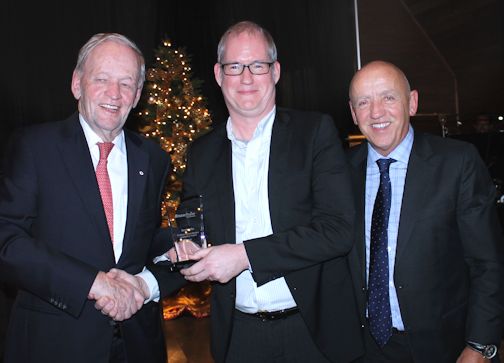
Duncan Hawthorne, president and chief executive officer of Bruce Power, announced the establishment of the Chretien Global Nuclear Leadership award, to be presented annually to a Bruce Power employee who provides leadership in his/her field in the international nuclear industry.
The first recipient is Scott Hilts, a manager in Bruce Power's Information Technology Division, who has played a leadership role working with the International Atomic Energy Agency (IAEA) in the area of cyber security.
The OSART Mission was conducted by international experts from around the world, led by the IAEA. They arrived at Bruce Power earlier this month and have just wrapped up their findings which will be released to the public in the new year.
The review focused on operational safety at Bruce B, assessing the safety performance using the IAEA's safety standards as a reference, and proposing areas where further improvements could be considered by the Bruce B management. It covered the areas of leadership and management for safety; training and qualification; operations; maintenance; technical support; operating experience; radiation protection; chemistry; emergency planning and preparedness; accident management; human, technology and organization interaction; and long-term operation.
Experts from the IAEA as part of this mission, were from Brazil, Bulgaria, Czech Republic, Hungary, India, Finland, France, Romania, Russia, Slovakia, Sweden, the United Kingdom, and the United States.
 Written By
Liz Dadson is the founder and editor of the Kincardine Record and has been in the news business since 1986.
Related Stories
No related stories.