



 July 6, 2026
698
July 6, 2026
698
“Summertime, and the living is easy.” For me, this line from a George Gershwin song evokes sandals, shorts, ice cream, fresh produce, afternoons spent in the water, and evenings spent around a fire under starry skies.
Those expansive night-time vistas are precisely the reason I moved to this area.
My husband’s hobby is astronomy and astrophotography. At the time when he finally had the occasion and financial wherewithal to begin investing in equipment, we lived in a small town and he was able to dabble and learn with a simple set-up in our backyard.
A few years later, towering light standards were erected at the soccer fields on the next block to allow for extended use. Suddenly the night sky was flooded with light and his view of the stars was washed out. The search for dark skies brought us to Blair’s Grove to a cottage with an open yard and a neighbourhood with few streetlights.
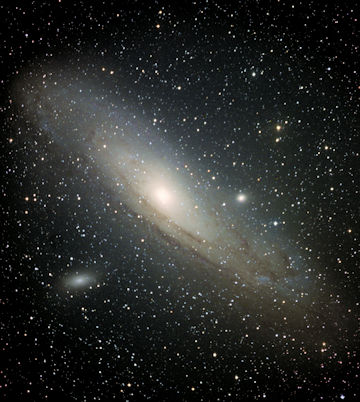
This long-exposure image of the Andromeda galaxy requires a dark sky; photo by J. Roberts
In the 20-plus years since, my neighbourhood has undergone steady development with more houses and permanent residents. Some embrace living closer to nature and enjoy sharing their landscape with the wildlife, trees and trilliums. Others seem determined to bring an urban aesthetic to the country with manicured, sprayed lawns and plants that belong on another continent.
One disturbing trend that’s particularly noticeable in summer is excessive outdoor lighting. Newer homes shine with fixed exterior lights under eaves and over entrances, and several properties are festooned with strings of party lights on decks and fences.
How people enjoy their property is none of my business, unless it impacts my enjoyment of my own property. My issue is that many of these lights shine all night and year-round. I often wonder if people would change their habits if they knew the damage light pollution causes the environment and humans. Hence, this month’s column.
One of my favourite early memories of summer in Bruce County is lying on my back on the deck at night looking up at the Milky Way and the feeling of looking into infinity. Sadly, due to light pollution, that’s a view fewer people can enjoy.
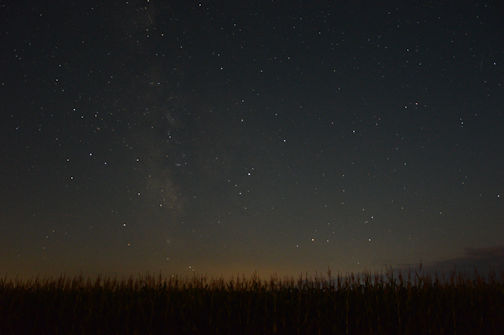
An awe-inspiring view of the Milky Way from Lake Range Drive; photo by O. Visser
Light pollution refers to the excessive or misdirected artificial light produced by human activities. Scientists estimate that 80 per cent of North Americans and 60 per cent of Europeans can’t see the Milky Way because of it.
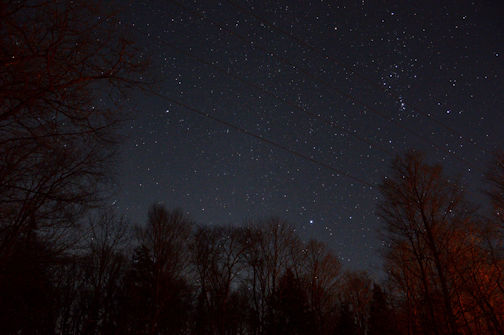
Many animals and insects navigate using the stars to guide them; photo by O. Visser
All life on Earth evolved to follow a cycle of day and night. When the cycle is disrupted by excessive night-time lighting, it can have serious consequences for animals, plants and humans.
Migrating birds often navigate by the stars. When they encounter the glow over urban areas, their ability to read the stars is hindered and can result in disorientation and collision with tall buildings.
Nocturnal species, such as bats and moths, also depend on darkness for navigation. Confusion resulting from excessive light impacts their ability to feed and find a mate, resulting in serious consequences for the population.
Fireflies, in particular, are negatively-affected by light pollution. As their name implies, these insects rely on flashes of light to communicate with potential mates. Too much artificial light in the landscape makes signalling more difficult and, ultimately, affects successful reproduction.
Important consequences for the environment of reduced insect populations are less food for birds and other animals, diminished control of unwanted insect pests which are preyed upon by bats and insect larvae, and decreased pollination of plants.
Plants also possess an internal clock. When normal rhythms are confused, plants may bloom too early and miss the pollinators they need for seed production. Trees may wake up too early or keep leaves longer, depleting the plant’s resources and making it weaker.
Humans created artificial light for safety and convenience. However, constant light affects us too. Disruption to our circadian rhythm by artificial light at night, suppresses the production of melatonin, a hormone that regulates sleep and supports immune function. This interference can result in poor quality sleep and has consequences for mental health and increased risk of chronic diseases.
Fortunately, light pollution is a relatively easy problem to address. DarkSky International (darksky.org/) is a non-profit organization that helps people and cities reduce light pollution. Its criteria for evaluating and improving home lighting includes five main points laid out in this graphic: (darksky.org/resources/guides-and-how-tos/lighting-principles/)
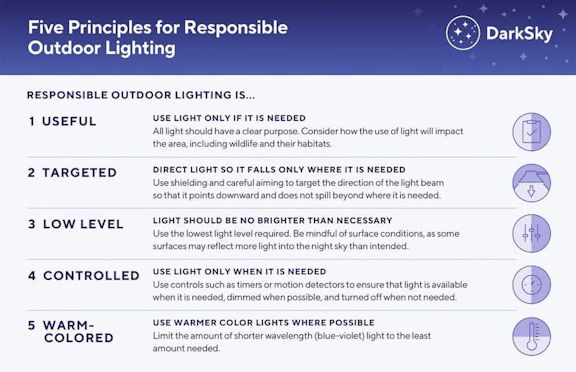
This graphic from DarkSky International lists criteria for assessing home lighting needs and uses
In addition to the many negative impacts of light pollution, it’s also worth noting that excessive lighting is a waste of energy and financial resources. The use of timers and motion sensors on many outdoor lights is good for the environment, your pocketbook and relations with your neighbours.
We are so fortunate to have access to the wonder and awe of the night sky. We should turn out the lights and enjoy the show every chance we get.
Written ByChristine Roberts is a retired elementary school teacher, past-president of Huron Bruce Nature, executive member of the Ripley and District Horticultural Society, volunteer for the David Suzuki Foundation, VON volunteer fitness leader and a passionate lover of nature.
Related Stories
No related stories.