Study confirms Tiverton air quality reflects entire region
A study confirms air quality measured at the Tiverton air-monitoring station reflects the larger picture of air quality across the Grey-Bruce region.
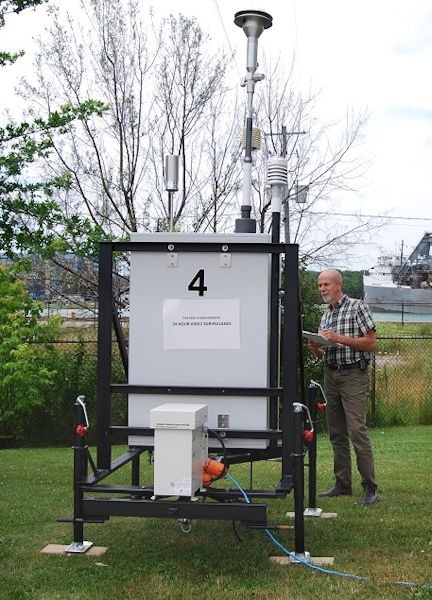
The Grey Bruce Health Unit and the Ontario Ministry of Environment and Climate Change conducted a study looking at ambient air quality in Grey Bruce. In a four-month period in the summer of 2015, a mobile air-quality monitoring unit, called an
Airpointer (in photo at right) was set up in three locations in Grey Bruce (Owen Sound, Hanover and Northern Bruce Peninsula). The portable unit measured ambient concentrations of three common air pollutants: ozone, nitrogendioxide and fine particulate matter.
The data collected at the three sites matched the data collected at the same time at the ministry’s Air Quality Health Index (AQHI)* Tiverton air-monitoring station. These findings confirm that measurements collected at the Tiverton air-monitoring station can be considered representative of measurements of common air pollutants across Grey Bruce.
In addition to the consistency of results across the region, the results of the study also show that air quality was very good during the sampling period. The Air Quality Health Index values were in the “low risk” category approximately 94 per cent of the time with the remaining hours in the “moderate risk” category.
“We are very pleased with these results," says Dr. Hazel Lynn, Grey Bruce medical officer of health. "They confirm that we have a reliable source of air-quality monitoring data in Tiverton that is representative of the entire region. The study also affirms the positive working partnership enjoyed between the Grey Bruce Health Unit and the local district office of the Ontario Ministry of Environment and Climate Change.”
The full report, Grey-Bruce Air Quality Study 2015, can be viewed on the health unit website at:
www.publichealthgreybruce.on.ca/.
*Air Quality Health Index is a tool developed by Health Canada and Environment and Climate Change Canada. The tool combines monitoring station data for common air pollutants in order to calculate a health risk score ranging from one (low risk) to 10 (very high risk). The public can use these scores to make decisions about activities related to both protecting their health and reducing emissions. In Ontario, air-quality data used to calculate local AQHI values is gathered by the environment ministry.
 Written By
No bio for this author.






Related Stories
No related stories.