



 November 4, 2026
103
 Although Halloween is past, the huge spider webs I observed in residential décor made me think of the bad rap spiders and other creatures, such as bats and snakes, get when it comes to having them in our yards. I think they need a public relations make-over.
Let’s start with bats and spiders since they seem to figure prominently in setting a spooky mood.
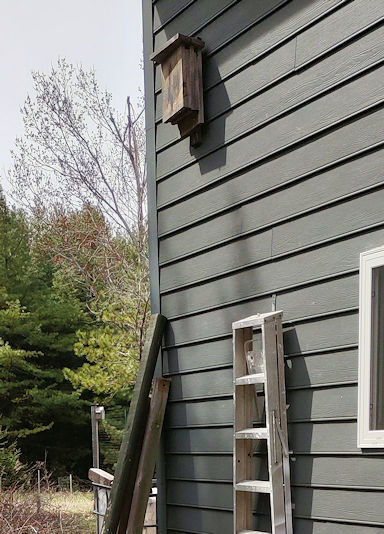
Providing artificial roosts (right) helps bats who, in turn, help control insect populations
Bats as Halloween icons make sense as they’re often associated with darkness and caves. Perhaps they seem mysterious because, as nocturnal animals, we rarely see them or perhaps it’s the cultural association with vampires.
We love to watch bats circling our yard when we’re outside for an evening campfire but I’ve actually had a guest express fear that a bat would attack and get tangled in her hair. Bats do not attack and are not pests. In fact, they are excellent pest-controllers as these aerial insectivores consume 50 per cent of their weight in insects every night. That’s estimated to be 3,000-4,500 insects: mosquitoes, moths, beetles and many others.
There are eight species of bats native to Ontario. The most common is the Big Brown bat. The Little Brown myotis is endangered due to the severe impact of white-nose syndrome, an invasive fungus which disrupts hibernation causing it to wake up frequently and exhaust fat reserves before insects are available in the spring.
It’s not surprising that the last week of October is International Bat Week, an annual celebration to raise awareness of the ecological roles of bats and the need for conservation.
Bats everywhere suffer from many of the same threats as other wildlife: habitat destruction/reduction and climate change which affects feeding and breeding grounds.
To help bats, plant native species of flowers, trees and shrubs to attract insects; eliminate pesticide use; and mount a bat box or four. We have a bat house on each side of our workshop so bats can move between roosts depending on temperature. There are several community science projects that members of the public can join to support bat research: Neighbourhood Bat Watch (batwatch.ca/) and the Toronto Zoo Bat Conservation Program (www.torontozoo.com/bats). Both websites provide excellent information about bats and bat conservation.
Is it the alien anatomy - eight legs, multiple eyes and strange body shape - that makes people fear spiders or is it the way they move, dropping down suddenly from above or darting out from hiding? Again, perhaps it’s cultural conditioning or learned behaviour from others. Regardless, like bats, spiders have enormous ecological benefit as insect consumers. They protect outside plants from harmful pests and are also great pest control inside the house. That may be a bridge too far for some people but they do keep indoor mosquito and fly populations in check.
Additionally, spiders are a hugely important link in the food chain as they are food for birds, amphibians, reptiles and small mammals.
 Once the fear factor is overcome, a study of spiders reveals a remarkable variety of shape and colour. There are more than 750 species of spiders native to Ontario, the vast majority of which are harmless, and even the bite of the rare northern widow spider is not fatal to humans.
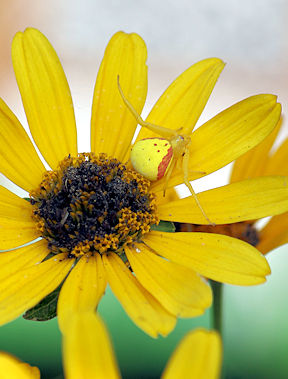
Our personal favourite is the crab spider which lurks inside flowers waiting patiently for unsuspecting pollinators. Usually white with some pink, goldenrod crab spiders can turn yellow for added camouflage.
The crab spider (left) is a patient hunter who changes colour to blend in with its surroundings
Another favourite is the yellow garden spider or the writing spider. This strikingly-patterned arachnid spins a large spiral web with a zigzag pattern near the centre. It is fairly large and is a great guardian of the garden.
This summer, I stumbled upon a spider whose body shape was entirely new to me. Because of its long, thin body and outstretched legs, I didn’t recognize it as a spider, at first. INaturalist identified it as a stretch spider that eats small insects, such as mosquitoes and flies, and is easily mistaken for a twig or blade of grass.
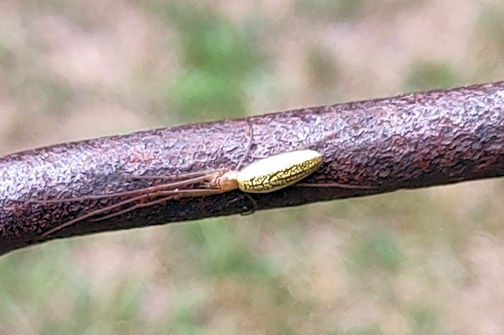
The stretch spider's long, thin body is easily mistaken for a twig
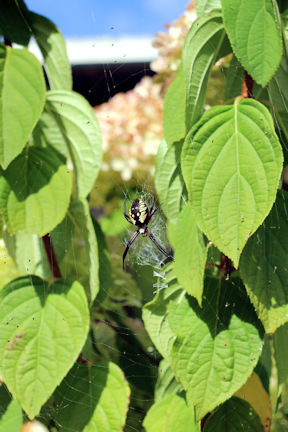 Many people are fearful of spiders and some homeowners seek to eradicate them by spraying their home’s exterior with insecticides. Sadly, this method of control is harmful to many other beneficial insects, some of which may be ingested by birds and animals. A more environmentally-friendly way to control unwanted spiders is to seal entry points, minimize outdoor lighting to stop attracting flying insects which then attracts spiders, and sweep away unwanted webs.
Large and fearsome-looking, the yellow garden spider (right) weaves a large web; look for the zigzag pattern near the centre
If interested in learning more about spiders, check out Ontario Nature’s spider guide: onnaturemagazine.com/spiderguide.html
While not necessarily a Halloween decorating staple, snakes nevertheless tend to evoke a strong fear response in people. Again, cultural conditioning plays a role and perhaps there’s even an ancient evolutionary response. Their silent and quick movement can be startling even to inveterate snake-lovers.
Snake populations suffer from habitat loss and like turtles, road mortality. However, snakes also suffer unjustly from human persecution. We have “Brake for Turtles” and “Brake for Snakes” magnets on our cars. Everyone seems to be in agreement regarding turtles but when it comes to snakes, we’re sometimes asked, “Why?”
Snakes help protect gardens and crops by eating large quantities of insects, slugs, snails and rodents. They are also an important food source for many predators, such as birds of prey, foxes and coyotes.
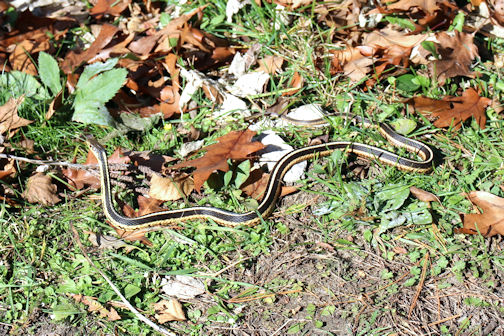
The garter snake is the most common snake native to Ontario; this fine specimen was hunting near our pond Nov. 1
There are 17 species of snakes native to Ontario, nine of which are classified as “at-risk.” The most common species are the Eastern Garter snake and Dekay’s Brown snake. The Eastern Massasauga Rattlesnake is endangered and Ontario’s only venomous snake, found in small pockets of the Saugeen Bruce Peninsula, Eastern Georgian Bay and near Windsor and Port Colborne.
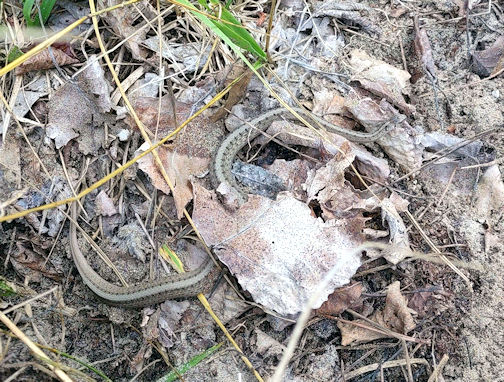
DeKay’s brown snake is another very common Ontario snake
We not only appreciate the existence of snakes on our property, we actively try to attract them by providing overwintering habitat in the form of a hibernaculum. Built using plans on the Toronto Zoo website (www.torontozoo.com/adoptapond/habitat/hibernacula), the snake pit, as I like to call it, is deep enough to allow snakes to pass the winter below the frost line. It’s filled with rubble to provide crevices and pipes that lead to the outside for a quick exit if the water table rises. Outside the mound, we’ve placed a wooden board on the ground. The board absorbs heat in the spring and snakes can be found warming themselves underneath.
It may take some time for snakes to find and choose a new wintering habitat but this spring, we were pleased to find several garter and brown snakes under the board.
To learn more about Ontario snakes, go to: ontarionature.org/programs/community-science/reptile-amphibian-atlas/species/#snakes
Each of these predators is unique in its anatomy and each plays important environmental roles by controlling pest species and by feeding other animals higher up the food chain.
It’s important to recognize that everything in nature is connected, and trying to avoid or control one species may have unintended effects on another. Fewer bats, spiders and snakes may result in higher populations of pests, such as mosquitoes, flies and rodents. Understanding relationships and developing empathy for all parts of nature will allow us to live in harmony in a healthy environment. While we can enjoy the thrill of scary creatures at Halloween, let’s not forget the many benefits of having bats, spiders and snakes in our backyards.
Written ByChristine Roberts is a retired elementary school teacher, past-president of Huron Bruce Nature, executive member of the Ripley and District Horticultural Society, volunteer for the David Suzuki Foundation, VON volunteer fitness leader and a passionate lover of nature.
Related Stories
No related stories.