


 October 23, 2016
1481
October 23, 2016
1481

Andrew Robertshaw has a passion for the First World War, also known as the Great War and the War to End All Wars.
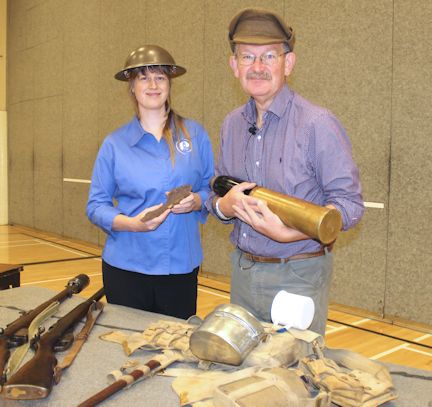
The military historian, author and broadcaster, who lives in Faversham, Kent County, England, brought that enthusiasm to Kincardine District Secondary School, Wednesday morning, in a presentation that focused on the Battle of the Somme which happened 100 years ago.
“Why do we want to make this stuff interesting?” he asked. “Because we are all survivors of the First World War. My grandfather, John Andrew Robertshaw, served from 1916-19. He was at the Battle of the Somme. My grandmother worked in a munitions factory. She was home sick the day that factory was bombed. She lived, so I'm here today.”
Robertshaw has spent more than 25 years on projects related to the Western Front, ranging from battlefield tours to archaeology, and the forensic investigation of Great War film. This has resulted in two television series, “Finding the Fallen,” and “The Trench Detectives,” in addition to contribution to other television documentaries.
“I've talked to veterans who were in the trenches,” he said. “They remember it in colour, not black and white, like we see it.”
Robertshaw said the Battle of the Somme was fought in the wrong location, with the wrong ammunition, and with an ill-trained army.
“Sir Douglas Haig, a British senior officer, was in charge of the battle,” he said. “He was called the 'Butcher of the Somme' because that battle ended with the highest number of casualties in British military history.”
The First World War began in 1914, said Robertshaw, when Germany invaded France through Belgium which was a neutral country. England then joined forces with France and Belgium and fought back. Germany's plan to take Paris failed so the German forces dug in, building trenches and pointing their rifles and artillery guns at the Allied forces.
While the politicians were negotiating, the war continued. By 1915, it was called the Great War, and at the end of 1916, it was the War to End All Wars.
The problem for Britain, said Robertshaw, was its army was not nearly as large or robust or well-trained as the German soldiers. That changed by the end of the war, with the arrival of soldiers from Canada, Australia, New Zealand and other Commonwealth countries.
The Battle of the Somme was fought at the Somme River, with the Allies set to push back the Germans, said Robertshaw. It was to be a four-day operation, beginning June 24, 1916. However, it was postponed to July 1, due to inclement weather, so the airforce could see where the shells were falling.
The battle went for 140 days. Britain had staggering losses of 19,000 soldiers, out of 57,000, the very first day. By the end of the operation, there were 1.2-million casualties, the bloodiest battle ever, with Britain losing 420,000 men, and France, 204,000, for a total of 624,000; while the Germans lost 600,000-plus soldiers.
Robertshaw said veterans of the First World War found it troubling when the Second World War broke out, because they felt that their fighting had been in vain.
“I do not advocate war,” he said. “I advocate an understanding of history so we don't make the same mistakes in the future.”
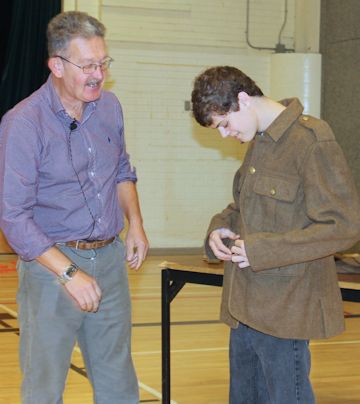
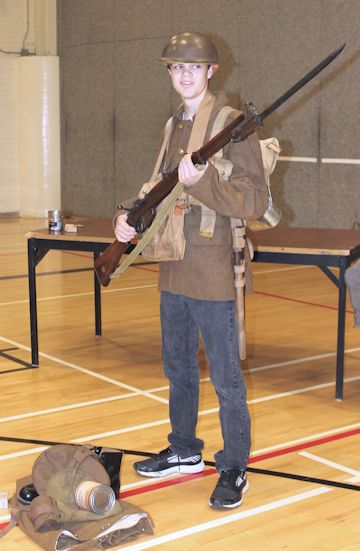
Robertshaw then outfit volunteer Brady Masur, 17, a KDSS student, in a First World War uniform, complete with tunic, helmet, backpack, mess kit and a rifle with a bayonet. The gear weighed about 35-38 kilograms, similar to carrying your younger brother around on your back. He said the average age of soldiers was 16, and the average height was five-foot, three-inches. The British soldier was called a “Tommy.”
“I love my job,” said Robertshaw. “I love the opportunity to come here and talk to you about the First World War. As you know, Nov. 11, 1918, was Armistice Day when both sides agreed to end the fighting. But the war didn't end until 1919. There was still fighting in Afghanistan and Russia."
Following the presentation, Robertshaw answered several questions from the students.
Besides a military historian, author and broadcaster, Robertshaw is also an actor. In 2011, he was the military consultant for Steven Spielberg's movie, “War Horse,” in which he also appears. Since 2014, he has been busy with the 100th anniversaries of the various battles of the First World War. He is a consultant for the BBC and runs a large number of events in the United Kingdom and in France, Belgium and Canada.
One major project has been the development of a replica trench system in England which will be used for teaching and experimental archaeology. His new publications include “24 Hours Under Attack,” “Trench Warfare,” and “The Somme.”
Robertshaw has ongoing battlefield tours and is now setting them up for 2017. Those interested, should contact him through his E-mail address, at andy@andyrobertshaw.com




 Written By
Liz Dadson is the founder and editor of the Kincardine Record and has been in the news business since 1986.
Related Stories
No related stories.