Natural gas, OPG's DGR top the list of priorities for Huron-Kinloss, says Twolan
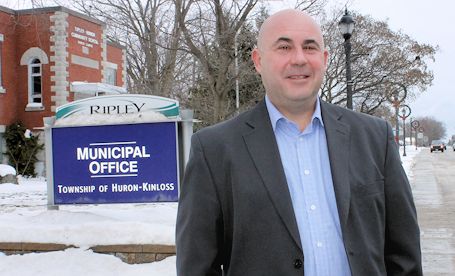
The past year has been a successful one for Huron-Kinloss, but the focus for 2017 will be on the natural gas project and Ontario Power Generation (OPG)'s proposed Deep Geologic Repository (DGR) for low- and intermediate-level nuclear waste at the Bruce Nuclear site.
That's the word from mayor Mitch Twolan who last month was also named warden of Bruce County for a third term.
“2016 was a very positive year for the township,” he said. “The number one thing for this area is natural gas. We went through the Ontario Energy Board (OEB) generic hearing in April, and the decision was announced in November. That decision was key – the OEB listened and a lot has changed because of the effort the three municipalities put into that process.”
Huron-Kinloss, Kincardine and Arran-Elderslie have been working for the past five years to bring natural gas to this area, and had signed a franchise agreement with EPCOR to move the project forward, prior to the OEB hearing.
“Hopefully, this (OEB ruling) puts us one step closer to bringing natural gas here,” said Twolan. “It's been a long, drawn-out process.”
Speaking of long, drawn-out processes, he said the next priority is the OPG DGR project which has been ongoing for a decade-and-a-half. Additional information has been presented to the federal environment minister, and a decision is expected in August of this year.
Twolan said that when he was at the International Conference on Geological Repositories in Paris, France, the first week of December, he visited a repository site laboratory which was 455 metres (1,500 feet) deep in the ground.
“Their geology is different to ours,” he said. “They drilled out a tunnel and put concrete on the floor. This site is strictly for testing, not for long-term storage.”
He said the closest region to the site, is the Town of Bure about five miles away, with a population of 400. The site has three to four different facilities and 650 staff, plus 300 people working there, and the economic spin-off is about $40-million (Canadian).
“The main thing there is transportation,” he said. “They are shipping spent nuclear fuel around the country every day, for reprocessing.”
Twolan said the company tried open public meetings, but the anti-nuclear faction took over. So, a company was hired to conduct public input on-line through E-mail and it worked very well.
“We could get to that point here,” said Twolan. “Ironically, Germany next door, got out of the nuclear industry and is now the largest importer of nuclear energy in the world.”
Twolan said he spoke to a geophysicist from Switzerland who had visited the Bruce Nuclear site. “He told me that the rock at that site is beautiful; it's the best in the world for hosting a DGR.”
The bottom line, said Twolan, is that something has to be done with the low-level and intermediate-level nuclear waste. “The status quo is not acceptable. What we have is safe but it's not a permanent solution.”
The trip to Paris, said Twolan, was very interesting but he had no time for sight-seeing. The six-day conference had a tight schedule, set by the Organization of Economic Co-operation and Development, which oversees economic development around the world.
“I went there as the mayor of Huron-Kinloss, because we are one of the nine municipalities still under consideration for a DGR for used nuclear fuel (under the Adaptive Phased Management process with the Nuclear Waste Management Organization),” he said, adding that Finland has already been granted a construction licence for a spent-nuclear-fuel DGR, and Sweden will be next.
Twolan also travelled to Washington twice last year, as chairman of the Great Lakes-St. Lawrence Cities Initiative. Once, was a follow up to the Climate Change Conference in Paris, in December, 2015; and secondly, for Great Lakes Days at the White House.
“We are so prepared in Canada, with regard to drinking water protection,” he said. “When I was in the U.S., I talked about the importance of sourcewater protection. Through the Great Lakes-St. Lawrence Cities Initiative, I was appointed to the Great Lakes Guardian Council. I'm the only municipal politician on that board, with people from Ducks Unlimited, the World Wildlife Federation, and the Ontario Federation of Agriculture.
“Last October in Toronto, the environment minister's opening remarks were about the Pine River Watershed Initiative Network (PRWIN) – how people are working together to improve the watershed.”
Twolan said the executive director of the Great Lakes-St. Lawrence Cities Initiative spoke in Toledo and referenced the PRWIN as a model for others to emulate.
“Here we are, little Huron-Kinloss, and we are leading the way,” he said.
VOLUNTEERS MAKE THE TOWNSHIP A GREAT PLACE TO LIVE
As for 2016, Twolan said Lucknow's Music in the Fields was another huge event, thanks to the Lucknow Kinsmen and their many volunteers.
“I just can't say it enough, that our volunteers put so much time and effort into this community. They are the reason this is such a great place to live.”
The past year was another successful one for construction, said Twolan. “We are very excited about the Bruce Power announcement. The benefit for this community is huge. I tell people around the world that we have a company in our community that is investing $13-billion, and they can't believe it.”
He said that as Bruce County warden, he is pleased with the economic development partnership between the county and Bruce Power, and he is looking forward to the Bruce County 150
th anniversary celebration, and Canada's 150
th anniversary celebration, this year.
Financially, he said Huron-Kinloss will be fiscally sound with the final payment this year on the Lake Range Drive extension.
“Then, we are completely in the black,” he said. “I credit our staff; we have the best around. That's what has helped us get where we are today.”
Looking ahead to 2017, Twolan said it's natural gas, natural gas, natural gas.
“That's our number one focus,” he said. “It's in the people's best interests, and it's the right thing to do. There are people struggling to pay their hydro bills and still put food on the table.”
He stressed that nobody will be forced to hook up to the natural gas line, but there will be major savings for business, industry and individuals, as well as the municipality.
Twolan said budget talks are coming up next month. Two major projects, are the water towers in Lucknow and Ripley, at a cost of $2.6-million each; grant applications have been submitted for both.
“I'm looking forward to all the Bruce County 150 events, and Canada 150, throughout the year.” he said. “Huron-Kinloss, along with other communities, will be planting a tree. There will be lots of fun stuff to do.”
 Written By
Liz Dadson is the founder and editor of the Kincardine Record and has been in the news business since 1986.




Related Stories
No related stories.