W5 draws small crowd to town hall meeting about OPG's proposed DGR in Kincardine
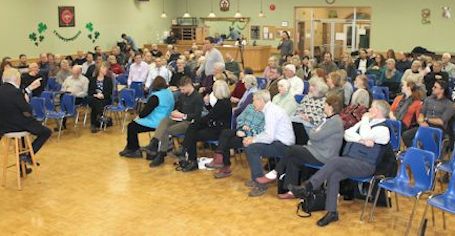
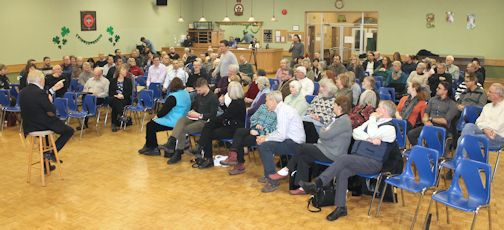
About 80 people battled the snowstorm Friday night to attend a town hall meeting and make their views known about Ontario Power Generation (OPG)'s proposed Deep Geological Repository (DGR) for low- and intermediate-level nuclear waste to be located at the Bruce site in the Municipality of Kincardine.
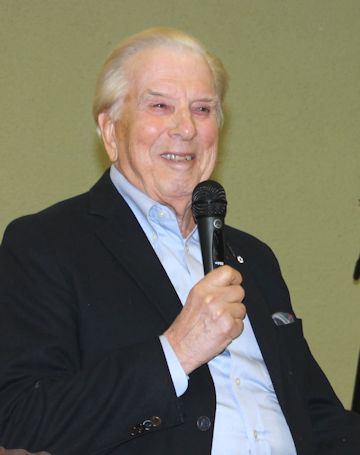
Hosted by CTV's W5, Canada's most-watched current affairs and documentary program, the meeting was held at the Kincardine Legion and moderated by Lloyd Robertson.
For the most part, there were as many people in the audience in favour of the controversial project as there were against it.
The proposal first came forward in 2001 and debate has raged since about 2010, culminating in lengthy Joint Review Panel hearings in 2013-14 and again in 2015. The decision on whether to allow OPG to proceed with a licence for site preparation and construction, currently rests with the federal environment minister and is expected sometime later this year.
Robertson admitted that W5 is late in the game on this issue. However, the story gained prominence recently with proponents and opponents, worldwide, signing petitions in favour and against the project. And interest has piqued with the possibility of a decision within six months to a year.
He cautioned the audience that W5 was just seeking opinions from both sides, and urged speakers to be concise. He also noted that not every speaker would be included in the final show, expected to air April 1.
Dave Trumble of the Grey-Bruce Labour Council, supports the DGR and wants to see it completed at the Bruce Nuclear site. He said plenty of studies have been done and peer-reviewed, indicating the project will not harm the lake.
“I have raised two children here and I'm comfortable with the work being done at the plant and with the proposed DGR,” he said. “The regulatory process is robust and rigorous and has answered all the questions.”
Mike Gade has lived in Kincardine for 27 years and raised his family here. “The waste already exists at the Bruce site. It has for 40 years since the start of nuclear power here. Building the DGR makes good sense. And we should do it because it is the socially-responsible thing to do.”
Others agreed with that statement, saying this generation should proceed with the permanent, long-term storage of low- and intermediate-level waste, rather than leaving the problem for future generations.
Doug Hunter, a cottager in the area, argued that the information that OPG presented in response to further requests from the environment minister, were ridiculous alternate locations where you couldn't build a DGR, such as downtown Toronto and under the Burlington Skyway.
Fred Kuntz of Port Elgin, OPG's corporate relations and communications manager for Bruce County, responded by saying Hunter's statement was incorrect. OPG used various regions to consider alternative sites for the DGR, but the result was that moving to another site was no safer or economically-sound than building at the Bruce site.
Marti McFadzean of Inverhuron, challenged Kuntz's remarks, and said she has great concerns about the project. When the most recent report came out from OPG, regarding further information for the minister, McFadzean said she read it but it did not help her.
“I would like clarification,” she said. “Regarding the science behind it, that's a large field. I'd like to know specifically what science was used. There are other alternate locations. I'm not crazy about it being next to the lake.”
Paul Kuratczyk of Kincardine supports the DGR, and said the low- and intermediate-level waste is already here on the shores of Lake Huron. “If this isn't built in our backyard, then whose?”
Dr. Sandy Greer, a resident of South Bruce and founder of Awakening to Possibility, Inc., a company whose focus is to help individuals discover their innate capacity to make a life-affirming difference in the world, spoke against the DGR, as she had through all the Joint Review Panel hearings.
She said the Environmental Assessment (EA) regulations have serious flaws which allowed OPG to make certain decisions, and there is not yet enough evidence or the proper scientific tools in place to approve this project.
Lise Morton, OPG's vice-president of nuclear waste management, said this project has undergone 10 years of scientific study and those studies have been independently verified by 100s of scientists, nationally and internationally.
“The Joint Review Panel consisted of three members with distinguished backgrounds,” she said, “and the panel strongly recommended going forward with the DGR. The proposal is based on sound science. The rock under the Bruce site is some of the tightest rock that exists. OPG takes its responsibility for water very seriously. Our employees take stewardship of that water seriously.”
She said OPG did look at alternative locations, but the safety case did not improve and the environmental effects increased.
Charles Hazell of Southampton, a member of Save Our Saugeen Shores (SOS) which opposes the DGR, offered up considerable information about the problems with the project and the lack of proper study, all of which had been presented at the Joint Review Panel hearings.
This prompted Liz Dadson, reporter with the Kincardine Record, to stand up and argue that the opponents of this project had their say at those hearings and yet the panel came back with a recommendation to build the DGR “sooner rather than later.” So, why don't we just build it?
Several others spoke for and against the project.
Robertson asked Trumble why people in Canada and the United States are now so concerned about the DGR.
Trumble said the problem is that the opponents have portrayed the project incorrectly.
“What they're saying is that OPG wants to build a nuclear waste dump on Lake Huron,” he said. “That's a little different to the reality which is that the waste is carefully managed and would be carefully placed in a DGR where it would be properly handled and monitored over the long-term.”
Julie Fair of Kincardine said her family has lived here for six generations, and Lake Huron is very dear to them and to the community of Kincardine.
“Nobody wants to see the lake threatened by the DGR,” she said. “However, I was here when the first CANDU nuclear reactor was built and there was a lot of fear about the safety of it. That fear was real to us, but now over the years, we realize there is no chance of anything happening.”
She said the same holds true with the DGR - studies have been done for the past 15 years, and it's time to stop discussing it and get it built.
Cati O'Brien of Kincardine urged the DGR opponents to come up with a better idea. “Until we have a better solution, this is what we need to do. Let's put this material where it's safe.”
 Written By
Liz Dadson is the founder and editor of the Kincardine Record and has been in the news business since 1986.





Related Stories
No related stories.