Ripley Horticultural Society learns about invasive species at meeting
Members of the Ripley and District Horticultural Society gathered at the Ripley-Huron Community Centre, Wednesday, to learn about invasive species.
Guest speaker Tineasha Brenot is a coastal technologist with the Lake Huron Centre for Coastal Conservation. She was accompanied by Erinn Lawrie, the coastal centre's executive director.
Brenot began by introducing the coastal centre and providing an overview of its work.
A non-profit charity, the coastal centre's core goals are protecting and restoring the Lake Huron coastal environment and promoting a healthy coastal ecosystem. Public involvement and education are encouraged through a variety of projects and resources which are listed on the centre's website:
www.lakehuron.ca.
A major initiative is management of Phragmites Australis at the Brucedale Conservation Area. Phragmites is a highly-aggressive invasive species that has taken over sensitive coastal wetlands but is now being successfully removed by an amphibious cutting machine.
The presentation continued with an explanation of the difference between native and non-native species and at what point non-native species can be classified as invasive.
Many gardens contain plant species that are not indigenous to the specific region. However, if a plant variety grows aggressively and becomes dominant in the ecosystem, it can cause damage by decreasing biodiversity, perhaps affecting a food source or disrupting sensitive migratory corridors. The impact can be far-reaching and difficult to predict.
Garlic Mustard is a good example. A highly edible plant, it is considered invasive because it is a fast-spreading forest cover that shades out other species, including the trillium and some orchids.
Common garden “escapees” considered invasive, are Periwinkle, English Ivy and Goutweed. These popular ground covers also over-shade the forest floor which can create food shortages for pollinators.
Invasive species impact not only natural ecosystems; their spread can affect enjoyment of landscapes, and control can be very costly to homeowners, municipalities and conservation authorities.
Brenot concluded her address by sharing resources to aid in identifying and reporting invasive species and choosing non-invasive plants for the garden.
Horticultural society members enjoyed the informative talk and discussed it extensively over refreshments at the end of the meeting.
The remainder of the gathering was occupied with business items on a wide range of topics, the most pressing of which were plans for the Ripley Fall Fair parade.
The next meeting takes place Wednesday, Oct. 18, at 1:30 p.m., at the Ripley-Huron Community Centre.
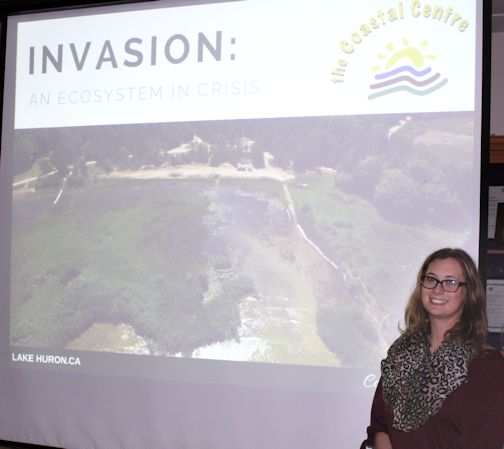 Tineasha Brenot, coastal technologist with the Lake Huron Centre for Coastal Conservation, speaks about invasive species at the Ripley and District Horticultural Society meeting, Wednesday, at the Ripley-Huron Community Centre; photo by Christine Roberts
 Written By
No bio for this author.




Related Stories
No related stories.