Hindu Festival of Lights, Diwali, begins this week
The largest and brightest of Hindu festivals, Diwali, begins Tuesday (Oct. 17) and spans a total of five days.
Widely accepted as the world’s oldest living religion, Hinduism in its current form is a combination of religions and belief systems which originated in India. Central to the religion are three important principles: reincarnation of the soul, law of cause and effect (karma), and the belief in one absolute being who can manifest in many forms.
Known historically as
Sanatan Dharma (eternal order), Hinduism’s beliefs are rooted in the teachings outlined in a few key spiritual texts. The formal composition of one such text, the Rigveda, has been dated back to 2500 B.C. and is contended by many scholars to have originated in oral form as far back as 6500 B.C.
The term "Hinduism" or “Hindu” does not appear in any of the Scriptures, and was introduced by foreigners referring to the inhabitants of the
Indus River region. The collection of Scriptures, referred to as
Shastras, outline the spiritual laws/teachings of various ancient sages from different points in its long history.
These can be placed into the following four categories:
Shruti (heard),
Smriti (memorized),
Purana/Itihas (legends/history) and
Darshan (governing philosophy). The first two were passed on from generation to generation orally for centuries before they were transcribed in Sanskrit. The most popular Hindu texts include the Bhagavad Gita, the Upanishads, Shrimad Bhagavatam and the epics of Ramayana and Mahabharata.
The goal of an ideal human life, as outlined in these Scriptures, can be defined by four concepts: Dharma (ethics and duties),
Artha (work and prosperity), Kama (passion and desires) and
Moksha (liberation from the cycle of birth and death). The practice of Dharma is important in our day-to-day lives because it leads directly to Moksha. If Dharma is neglected in favour of the purely material pursuits of Artha and Kama, life becomes chaotic and Moksha or eternal peace cannot be attained. Essentially, Hinduism is a pacifist and inclusive religion and a Hindu is one who lives a life of compassion, honesty, truth, prayer and self-regulation.
The Hindu calendar is lunisolar, and its traditional holidays are linked to the cycles of both the sun and moon. Many of these
holy-days celebrate deities, but on a deeper level represent abstract themes of the human condition, such as the moral triumph of wisdom over ignorance (Ram Navami and Krishna Janmashtami). Other festivals celebrate important aspects of life such as family bonds. An example of this is
Raksha Bandhan and Bhaiya dooz, when brothers and sisters celebrate their enduring and beautiful sibling relationship.
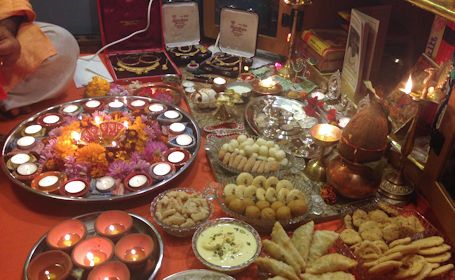
Diwali is celebrated by Hindus, Buddhists, Jains, and Sikhs around the world and signifies the triumph of good over evil. Its direct translation is “Rows of lights/lamps where the light is an important physical and spiritual symbol of this holiday." People gather at temples or commonplace, demonstrating their commitment to sacrifice and charity by offering food, sweets and gifts to others. People also perform firework displays.
For many Indians, Diwali honours Laxmi, the goddess of wealth and prosperity, and Ganesh, the god of wisdom. Families spend days cleaning and decorating their homes, shopping for new clothes, arts, crafts, gold ornaments and kitchen utensils.
Diwali is a national holiday in India, Trinidad and Tobago, Myanmar, Nepal, Sri Lanka, Guyana, Surinam, Singapore, Fiji and Malaysia. Given Canada’s large Indian population, Diwali is celebrated in a big way as thousands of people attend community-organized events in major cities, such as Toronto and Ottawa.
This year Canada Post and India Post jointly issued a Diwali stamp to commemorate 150 years of diversity in Canada and the strong relationship between the two countries.
Indians living in Bruce County are celebrating Diwali, Oct. 21, at the Underwood Community Centre. Happy Diwali!
 Written By
No bio for this author.




Related Stories
No related stories.