Results now available for 2017 Kincardine Christmas Bird Count
Every winter in mid-December, birders all over the western hemisphere conduct an important “Christmas Bird Count.”
This even began more than 100 years ago, and is the
oldest and
largest citizen science project on the planet. Data collected reveals bird population changes and shifts in home ranges. Monitoring bird populations is a good indicator of environmental conditions.
Of the 1,154 bird species in North America 432 are listed as ‘Species of Concern.' (For more information, google’ State of North American Birds.)
The highly-organized “Christmas Bird Count” is dominated by volunteers and last year, nearly 80,000 participants in 2,005 count circles counted an astonishing 59-million birds. Of the 2,607 different species seen, the most tallied was 509 in Ecuador. In all of Canada, 297 species were found and 185 were located in Ontario.
This year, the Kincardine Christmas Bird Count was held Friday, Dec. 15. Environment Canada had issued a ‘weather advisory’ and the dedicated 22 field participants battled poor visibility and wintry road conditions all day. They amassed 51 species which is average, but many birds were recorded in lower- than-typical numbers. Weather, snow depth and amount of ice coverage are all recorded so that compilers can relate conditions to bird numbers.
For example, normally we see several Bald Eagles but the single sighting this year is of no concern because it is attributed to weather conditions and not a decline in population. The Ring-necked Pheasant that made its fourth appearance is probably an ‘escapee’ for there is no known naturalized breeding population of pheasants in Bruce County. The White-crowned Sparrow seen in Point Clark has been found only one previous count and is probably surviving by visiting feeders.
The first ever Baltimore Oriole seen brought the historic 33-year total to 121 species. The Oriole was an anticipated find for it had been eating peanuts at a feeder on the south side of Kincardine for a week prior. Many people are familiar with the Oriole’s beautiful song and orange color during our summer months. Orioles, along with most song birds, migrate south but on occasion stragglers, get left behind.
A mega-rarity found in Bruce County earlier this year was a Rock Wren, which is native to the southwest and has been recorded in Ontario only twice before. This rare visitor seemed in its element on the rocky shores of Bruce Peninsula National Park, but because it was a ‘one day wonder’ in a park full to capacity, it was seen by only a fortunate few.
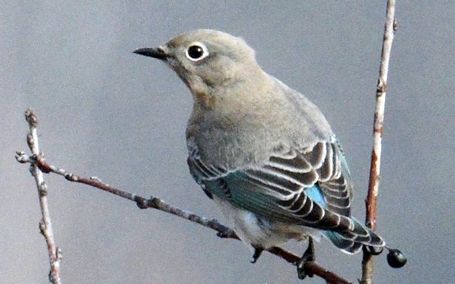
Recently, a Mountain Bluebird delighted birders by its appearance near Kitchener. Mountain Bluebirds are rarely found east of the prairies so this bird is a long way from home.
The Mountain Bluebird (above) was photographed near Kitchener by Bruce Edmunds.
When birds sporadically stray from their normal range, they create an exciting challenge and complexity in the birding world. In this Internet-connected world, the word gets out quickly and the ‘chase’ is on!
Most birders compile their own personal “Life List’ and many use the eBird website. Available also, is a mobile phone app for submitting eBird checklists that are instantly in the cloud. Prudent and dedicated birders will go to great lengths to see a new species. Some will even challenge themselves to a ‘Big Year.’ This ‘Big Year’ challenge is defined as an informal, personal competition to find the most species of birds in a given area (i.e. Ontario) in a calendar year.
Nov. 2, 2017, Jeremy Bensette’s sighting of a Northern Gannet near Hamilton broke the old record of 343 species and set a new ‘Ontario Big Year’ high. There is no ‘rest’ for a “Big Year’ birder until midnight, Dec. 31. Check out Bensette’s link for his ‘Big Year’ story and his results at:
www.cbc.ca/news/canada/windsor/this-man-travelled-90-000-km-across-ontario-to-break-a-bird-watching-record-1.4410182
Here are the complete 2017 Kincardine Christmas Bird Count results:
Canada Goose 182, Mallard 68, American Black Duck 11, Greater Scaup 1, Long-tailed Duck 7, Bufflehead 101, Common Goldeneye 31, Common Merganser 48, Red-breasted Merganser 29, Ring-necked Pheasant 1, Wild Turkey 64, Sharp-shinned Hawk 3, Cooper’s Hawk 1, Bald Eagle 1, Red-tailed Hawk 3, Rough-legged Hawk 8, Ring-billed Gull 6, Herring Gull 181, Great Black-backed Gull 2, Rock Pigeon 88, Mourning Dove 87, Snowy Owl 11, Red-bellied Woodpecker 2, Downy Woodpecker 20, Hairy Woodpecker 3, Pileated Woodpecker 1, American Kestrel 2, Northern Shrike 4, Blue Jay 93, American Crow 357, Common Raven 9, Horned Lark 6, Black-capped Chickadee 170, Red-breasted Nuthatch 21 ,White-breasted Nuthatch 9 ,Brown Creeper 1, Golden-crowned Kinglet 2, American Robin 1, European Starling 274, Snow Bunting 220 ,American Tree Sparrow 26, Dark-eyed Junco 215, White-crowned Sparrow 1, Song Sparrow 1, Northern Cardinal 84, Baltimore Oriole 1, House Finch 33, Purple Finch 4, Common Redpoll 1, American Goldfinch 498, House Sparrow 225.
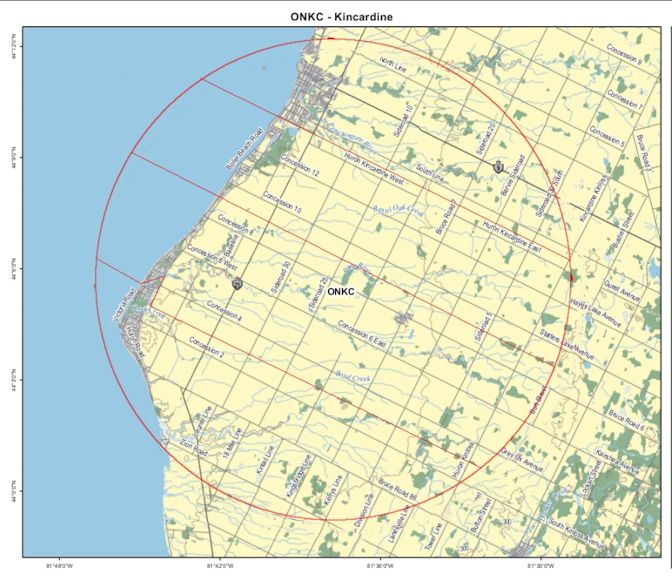 Anyone in the count circle (above) can add birds to the Kincardine Christmas Bird Count tally by contacting jaturland@gmail.com
If you enjoy watching the birds, looking at bird pictures or taking photographs, then consider getting more involved in some of the local bird-centred activities. The Bruce Birding Club has bi-monthly outings, seeing more than 200 bird species each year. The Huron Fringe Birding Festival, hosted at MacGregor Point Provincial Park, offers guided hikes two weekends in late May.
If you have seen an interesting species or would like more information, contact James Turland
jaturland@gmail.com
 Written By
No bio for this author.




Related Stories
No related stories.