Ripley 4-H Dairy Club learns about showing and judging dairy animals
The end of June was a busy time for the Ripley 4-H Dairy Club.
June 22, our timing was perfect when we met at NorBella Farms, on the 7
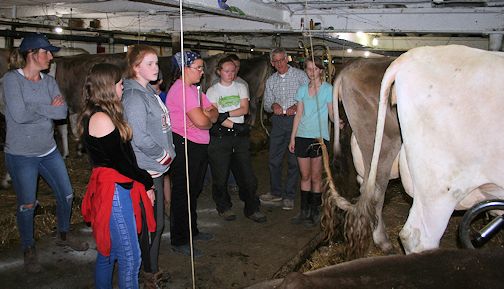
th Concession of Kincardine, just as Troy McConnell and his helpers were finishing up the evening milking. They held back four cows so we could watch their method of milking and clean-up process.
As with all meetings, we began with the 4-H Pledge and Roll Call: “Name one criteria important to you when buying food (grocery store, fast food, convenience store).” We had some great answers, including trans fats, vitamins, nutritional level.
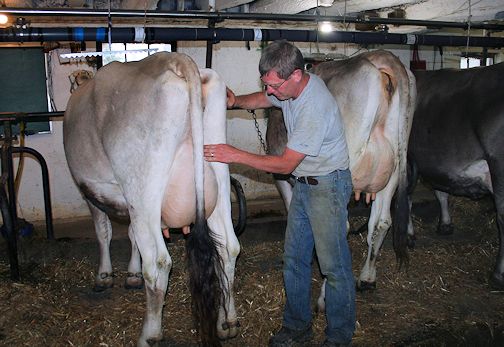
Before the cows were milked, the members were asked to judge the udders. We had a class of two-year-olds who were all three-and-a-half to five months out of their first lactation. As udders are not something typically judged in the 4-H ring, we asked Troy to give us some direction on what to look for – things such as rear and fore udder attachment, teat placement, median suspensory ligament or crease, udder texture, teat length and the udder floor.
When placing the class, the focus should be on the rear udder attachment, teat placement and the crease. We asked the members to place the class of udders and give the group their answer with reasons for the placing.
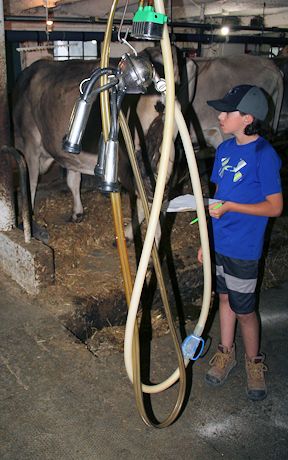
After their udders were judged, the cows were glad for their milking process to start. NorBella is set up with tie stalls, milking 36 Brown Swiss cows. The herd's average age is eight, with the oldest cow being 10. The pre- and post-drip processes are different in that the post-dip is a stronger concentration and the McConnells use brown kraft paper towels for wiping off the teats.
With a tie stall, the milker is attached from the cow’s side and some of the cows have a preference to which side they are approached with the milker. Our group of cows took two-and-a-half to three minutes to milk.
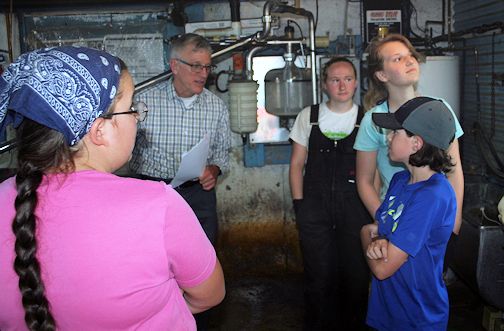
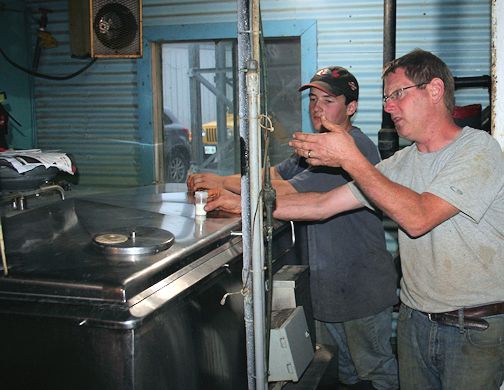
We were very keen to move to the milk house to watch the clean-up process and how the pipelines are thoroughly sanitized between milkings. We were fortunate to see the milk pipeline filter after milking and appreciate its importance.
As they were enjoying a snack, the members received a copy of the Parts of a Cow. We reviewed what we had seen in the barn during the udder-judging and the practical purposes for parts of the anatomy as well as other qualities which are important in the conformation of the animal, such as its depth of rib and its feet and legs (post versus sickle hock).
Members were also given a Parts of a Cow crossword puzzle which is to be completed for the August meeting.
To conclude our meeting, members were asked what they witnessed at NorBella which was different than other producers. They came up with quite a few responses including manual vacuum shut-off, cattle remain tied until all are milked, kraft towels, and tails are tied-up.
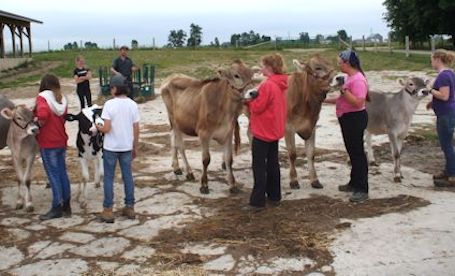
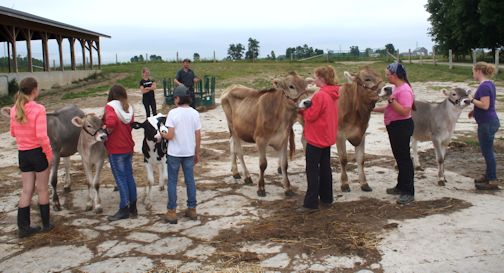
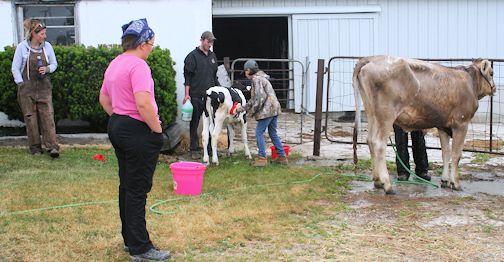
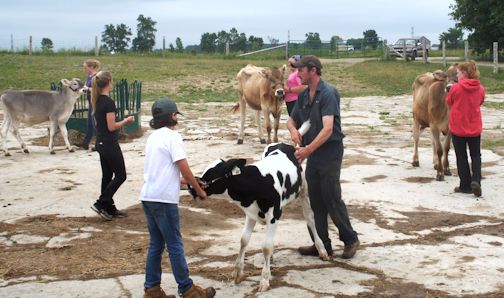
After a busy night, our club met back at NorBella Farms Saturday, June 23, at 10 a.m. for our Showing and Fitting day. We got right down to it with a washing demonstration as that’s where it all starts, with a clean calf.
For those who had not brought their calf, Troy was able to provide a few calves for our members. Armed with hoses, brushes and soap, members started the arduous task of washing their calves. We were fortunate to have a couple of seasoned veterans, Emily Franken and Dan Martin, at our meeting offering valuable tips.
The members with Holstein calves quickly realized white hair can be difficult to get completely clean. While Holsteins are black and white, the amount of black versus white hair varies considerably. Our veterans emphasized the importance of rinsing and more rinsing to ensure all the soap is out and suggested to have another team member check for soap residue.
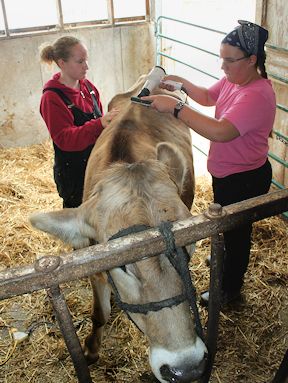
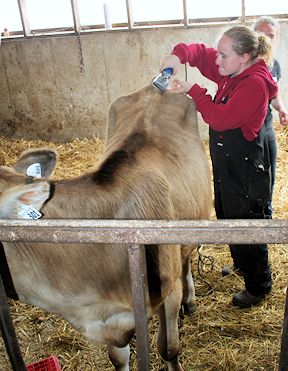
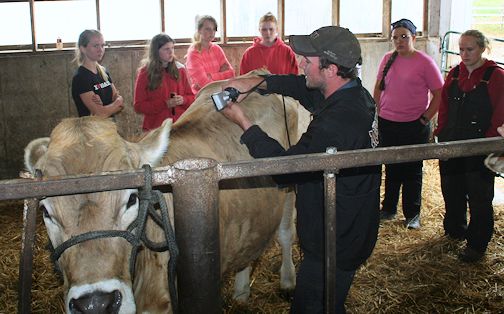
Next on our agenda was a clipping demonstration. Troy had three calves washed and ready for our clippers. Emily and Dan gave some initial instruction and then handed the clippers to the members. The hair started to fly as members got comfortable with shaving the hair and carving out the all-important topline.
The members quickly appreciated how long it takes to completely clip a calf and the importance of having a well-behaved calf; one that is accustomed to the sound of the clippers and doesn’t kick or move around too much. Members were also shown and then tried themselves, how to blow dry the topline of the heifers, another very important aspect when showing a dairy heifer.
After clipping, it was time for lunch! Our gracious hosts, Troy and Jacklyn McConnell, provided a great barbecue lunch with lots of side dishes and beverages.
We got the members up and moving after lunch with the showing demonstration. There is a lot to remember when showing a dairy calf and it starts even before you step in the ring. Both the calf and showperson’s appearance and behaviour are judged.
Emily and Dan acted as judges and ran the members through all that is involved from the moment you enter the ring, to the final line-up and leaving the ring. There was a lot of information provided and members were encouraged to ask questions and practise whatever they wanted.
One very important piece of information was to always keep an eye on the judge because even if he is across the show ring, he could still be looking at you, comparing you to someone else in deciding where to place you.
At the end of a very busy day, the calves were returned to their packs, and members had one last snack. While snacking, we reviewed Show Ring Ethics – a list of situations which the members had to decide whether it was ethical or not. A 4-H member should always strive to display ethical behaviour and fair play.
We adjourned at 2:30 p.m. and the members departed with lots of things to consider in the coming weeks as they prepare for their shows this summer and fall. Thanks to Troy and Jacklyn McConnell and family, including Norval, for being great hosts.
 Written By
No bio for this author.



Related Stories
No related stories.