Huron Fringe Field Naturalists learn about Bruce Peninsula Bird Observatory
On a chilly Tuesday evening, when many wished they could fly south, nearly 50 members of the Huron Fringe Field Naturalists welcomed Ann Range to speak about migration monitoring and other programs of the Bruce Peninsula Bird Observatory.
A recently-retired educator with extensive involvement in environmental and outdoor education and a lifelong passion for nature and birds, Range has served on the board of observatory and Saugeen Field Naturalists for many years. She lives near Wiarton on a farm dedicated to promoting and preserving bird habitat.
Also known as the Cabot Head Research Station, the observatory is located at the eastern tip of the Saugeen Bruce Peninsula within the boundaries of the Cabot Head Provincial Nature Reserve. At the northern end of the UNESCO Niagara Escarpment Biosphere region, in the last remaining stretch of contiguous forest, it is situated on an important migratory path for songbirds travelling north to boreal forests for summer breeding. More than 300 species of birds have been observed and recorded and at least 175 species breed on the peninsula.
The research station, comprised of two cottages purchased in 1998, has been in operation since the early 2000s and is run by a station scientist, Dr. Stephane Menu, a board of directors and volunteers.
Its main focus is migration monitoring of passerines (songbirds) in the spring from mid-April to early June, and in the fall from mid-August to the end of October. Over the course of six hours, beginning before sunrise, volunteers make frequent checks of nets set up in the forest. Captured birds are extracted, bagged and taken to the lab for banding and recording of biometric measurements before being released.
Other daily routines include a timed observation census of birds in the area, and recording and sharing of data with the Canadian Migration Monitoring Network, a network of 25 monitoring stations nationwide.
In the past few years, the observatory has also been involved with Species at Risk research, collecting data on grassland species (meadowlarks, bobolinks, savannah sparrows) and nightjars (whip-poor-wills and nighthawks). The observatory has also supported the Motus monitoring program by helping to attach transmitters to various bird species, such as the Swainson’s thrush.
The observatory receives some funding for research projects but relies heavily on volunteers, membership and donations to operate, maintain and upgrade the facilities. Visit
bpbo.ca/ to read Menu’s blogs and yearly reports or to learn more about volunteer opportunities, facility rentals and programs.
As a club, the field naturalists support the work of the observatory and enjoy reading the regular blog posts during spring and fall migratory operations. This presentation was an opportunity to gain a better understanding of the history of the research station and the details of its work. Members appreciated Range’s engaging and passionate address.
In other club business, new members were welcomed and dates were shared for outings scheduled in the new year.
The club takes an extended holiday break, reconvening Tuesday, Feb. 26, for a potluck lunch and photo contest at the Pine River United Church. For contact information check the groups folder at
www.huronstewardship.ca.
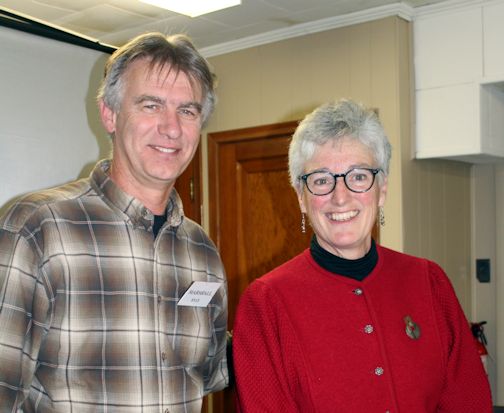 Marshall Byle (left) of the Huron Fringe Field Naturalists, thanks Ann Range for her engaging presentation about the Bruce Peninsula Bird Observatory; photo by Christine Roberts
 Written By
No bio for this author.



Related Stories
No related stories.