Award-winning author explains how to practise happiness habits
At the age of 70, most people are the happiest they will ever be in their lifetime.
That's the word from Jennifer Moss, award-winning author of “Unlocking Happiness at Work,” and co-founder of Plasticity Labs, a happiness research company.
Speaking to a crowd of about 75 at Pine River United Church, Tuesday morning, Jan. 8, the 41-year-old Moss explained that research shows we are happy until the age of 15, and then we go into a downward spiral to about the age of 40-50.
''Which makes sense,” she said. “At that age, we're parents and we're trying to juggle so much stuff – work, home, life. Then, we hit 70 and we're at the peak of happiness. We're grandparents. We enjoy the grandchildren without all the stress of being parents. And we have time to be with friends and family without all the stress.”
She admitted there is a lot of loneliness and depression at that age as well, for some people.
Moss, who lives in Kitchener with her husband, Jim and three children, is the daughter of Sally and Doug Young who live in Point Clark and attend Pine River United Church. Hence, the connection that saw the United Church Women invite Moss to speak about happiness and the science of gratitude.
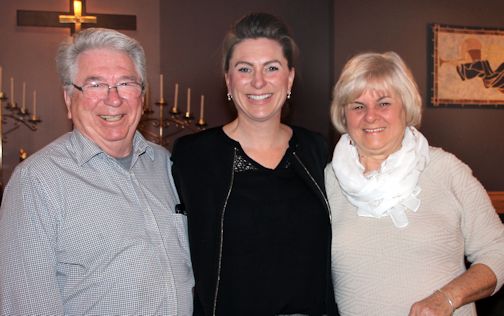 Jennifer Moss (centre) with her parents, Doug (left) and Sally Young of Point Clark
While much of her talk is about fostering happiness at home and in life, Moss admitted that she had to deal with post-traumatic stress after her own life took a sharp turn in 2009. Her 30-year-old husband, a professional lacrosse player, contracted West Nile Virus, swine flu and Gillian-Barre Syndrome while they were living in San Jose, California.
“I remember arriving at the hospital and Jim was intubated and the doctors were talking DNR (Do Not Resuscitate),” she said. “There I was, with a two-and-a-half-year-old, and eight-and-a-half-months pregnant, 5,000 miles away from family. It was very scary.”
Her husband survived thanks to the amazing doctors and a treatment that worked, said Moss. However, Jim was told he would never talk again.
“He had to re-learn how to do so many things, including how to walk,” said Moss. “Six weeks later, he walked out of that hospital, just in time to go back for me to deliver our second child!”
She said that as her husband tried to figure out what to do with his life, he practised an attitude of gratitude that he was still alive which helped him heal.
“We were so grateful for the health care he received,” said Moss. “We had to shift our priorities. We moved back to Canada, about a half-hour from where my parents lived in Cambridge, and Jim went back to school.”
Now, they work together at Plasticity Labs, helping people tap into happiness to feel better at school, at work and in their lives.
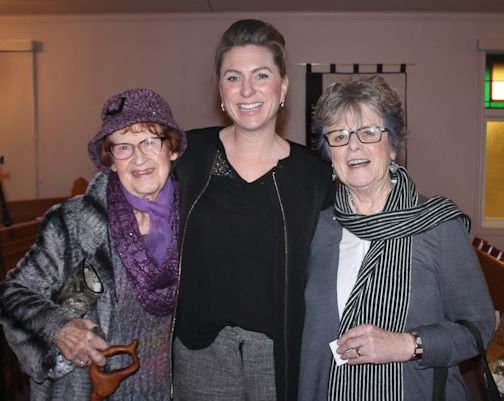 Guest speaker Jennifer Moss (centre) with Audrey Ferguson (left) and Corabelle Danahy, both of Kincardine
Moss said human beings were meant to physically be surrounded by people. “Years ago, you would form a tribe in order to be safe. It's important that we congregate with other people.”
She said we have so many factors weighing on us that try to steal our happiness, such as Social Contagions (drug use, depression, alcohol, divorce), Breaking News Disorder, and Over-Curation (stressed by the amount of things we have to accomplish).
“Over-Curation is especially bad for our kids,” said Moss. “We have such high expectations that we're not allowing our children to be kids. Our children should be allowed to play.”
Technology is another culprit, she said. “We are all so connected today. In one minute, there will be 204-million E-mails sent, 2.46-million Likes on Facebook, and 335,000 Tweets. Loneliness has doubled since the 1980s, and there is increased isolation.”
To combat all this, Moss outlined the HERO Generation (HERO-GEM), a non-profit that is implementing her gratitude-based HERO model in schools, with the following happiness traits: Hope, Efficacy, Resilience, Optimism, Gratitude, Empathy and Mindfulness.
She explained each trait, noting that people must set goals, believe in themselves, be grateful for what they have, adapt to stress and adversity, react to problems with a sense of confidence, listen and be aware, pause for a second and think before they act.
“Gratitude is about noticing, acknowledging and appreciating what we have,” she said. “Practise these happiness habits and it will change the way your brain thinks, incorporating the good tools.
"Always be aware of how your narrative affects others and don't forget to be joyful and laugh!”
For more information about her book and her work, check the website at
jennifer-moss.com
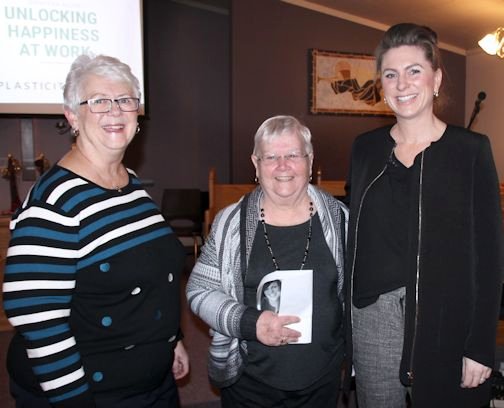 Glenna Farrell (left) and Lynda MacKenzie of the Pine River United Church Women, welcome guest speaker Jennifer Moss of Kitchener
 Written By
Liz Dadson is the founder and editor of the Kincardine Record and has been in the news business since 1986.



Related Stories
No related stories.