Bruce Power, medical isotopes about fighting cancer and saving lives, says Scongack
People need to understand the role that the nuclear industry plays in the production of medical isotopes used in fighting cancer and saving lives.
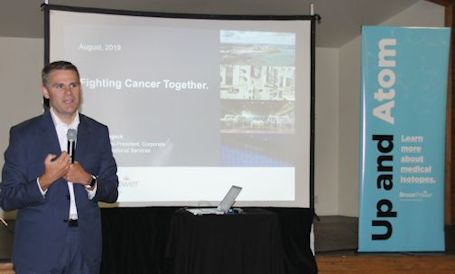
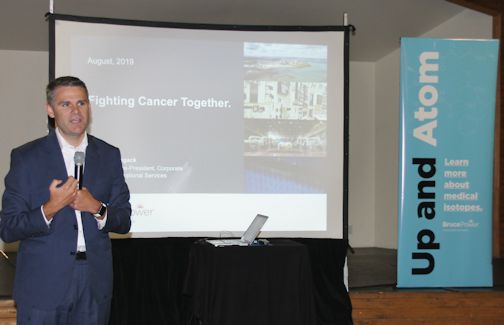
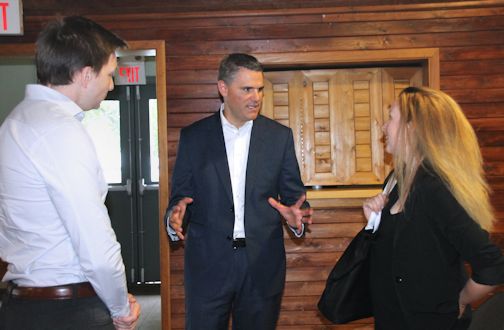
That's the word from James Scongack, Bruce Power executive vice-president of corporate affairs and operational services, as he spoke to about 75 people at the Kincardine Pavilion, during the “Up and Atom” breakfast session, Tuesday morning.
Emphasizing the importance of getting this message out, Scongack said that if people don't understand and support this role, then by the time they do, it will be too late, and the source of these medical isotopes will be gone.
He said people's health is improving, all around the world, compared to 20-50 years ago. This stems from the fact that their prosperity is improving, and they want access to better and safer medical treatments.
Thanks to medical isotopes, in the form of Low Specific Activity (LSA) Cobalt 60 used to sterilize medical equipment, and High Specific Activity (HSA) Cobalt 60 used in cancer treatments, medical procedures are safer, without the risk of a secondary infection, said Scongack.
The National Research Universal (NRU) reactor in Chalk River was providing these isotopes until its end life was announced for March, 2018, leaving a gap in the supply, while demand was increasing, said Scongack.
The Bruce Nuclear site has been producing Cobalt 60 for years, he said, so it was natural for Bruce Power to take on a leadership role in continuing to supply medical isotopes on a global stage. That led to the creation of the Canadian Nuclear Isotope Council which has 43 members from a variety of fields, including production, distribution, research and development, hospitals, doctors, etc.
“It was a great opportunity for Bruce Power,” said Scongack. “If we couldn't find a way to do this with our eight reactors, who do you think would? This is a complicated sector but at the end of this whole technical conversation, it's about helping people.”
On a personal note, Scongack said his daughter was born premature in 2012, and spent time in the Newborn Intensive Care Unit. The biggest scare was infection, but her isolette was sterile and she was safe.
“At that point, I had been working at Bruce Power for eight years and I did not know that we produced medical isotopes,” he said.
They are an important part of the health care system, said Scongack.
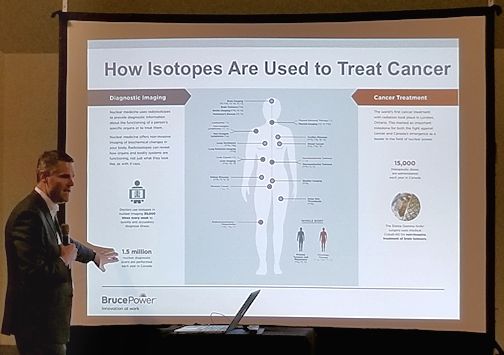
Across Canada, doctors use isotopes in nuclear imaging 30,000 times per week to quickly and accurately diagnose illness; 1.5-million nuclear diagnostic scans are performed each year; 15,000 therapeutic doses are administered each year; and about 20,000 patients undergo nuclear imaging procedures every week.
In the fight against cancer, the HSA Cobalt 60 powers a Gamma Knife which is used in the treatment of brain tumours, said Scongack, adding that a company in Maryland is also finding favourable results using it for treating certain breast cancers.
Work is now under way, with Kinectrics and Framatome, to develop a new medical isotope, Lutetium (Lu-177), for use in the treatment of prostate cancer, he said. Lu-177 has a half-life of seven days. The hope is to have it developed by 2021, and for production to begin in 2022.
“We have a neutron source (nuclear reactor),” said Scongack. “So, we can expose other elements to that source and develop more isotopes. The process is the same – you put a target in the reactor and it is irradiated to produce a medical isotope. Once the process is in place and we have a delivery system, we can do rare isotopes at a low cost. Then, the question is, what medical isotopes can we make in the future?”
Scongack said the Cobalt 60 can be created only in the Bruce B generating station which has absorbers, and takes three years before it can be harvested during a reactor outage. The Cobalt 59 is placed into the reactor through adjustor rods which sit in between the fuel channels. The reaction with the neutron source creates Cobalt 60.
During questions, Scongack said Bruce Power's main industry is generating electricity. The production of medical isotopes is an added bonus to that main industry.
“This may be one per cent of our revenue but it should be 50 per cent of our story,” he said. “People need to know and understand this. We're going to be in business for the next 50 years. The public needs to know that Bruce Power creates a multi-value product.
“It's important to communicate this part of our story so everyone knows. While we generate clean, low-cost electricity and protect the environment, we also produce medical isotopes which help people in a more direct way.”
At the end of the session, he presented each member of the audience with a pair of socks, labelled with medical isotopes. Proceeds from Bruce Power's purchase of the socks go to support the Pediatric Oncology Group of Ontario, and the Brain Tumour Foundation.
Similar "Up and Atom" sessions were also held in Southampton and Walkerton.
 Written By
Liz Dadson is the founder and editor of the Kincardine Record and has been in the news business since 1986.



Related Stories
No related stories.